
How does a septic system work?
Two stages, what each one does, and how to work out which of the two system types is in your own yard.
TL;DR
- A septic system works in two stages: the tank separates solids from liquid, and the soil under the drain field does the actual cleaning.
- Wastewater sits in the tank for at least 24 hours so heavy material can sink and grease can float before the liquid moves on.
- The tank is not a treatment plant. The soil is, and everything the tank does is in service of protecting it.
- In East Texas the soil texture decides whether a property gets a conventional system or an aerobic one, and that call belongs to a registered sanitarian, not to a budget.
- Most homeowners cannot say which of the two they own, and the two have completely different maintenance requirements.
I spend most of a pump-out talking. Not to be friendly. It is how I think through a job, so I say out loud what I am seeing as I see it.
What still gets me is how often the homeowner is hearing it for the first time. People who have owned a property for 10 or 15 years walk away from a 40-minute visit knowing more about their system than they did the whole time they lived there. Nobody ever showed them. The system is buried, it makes no noise, and until it stops working there is no reason to think about it.
So here is the whole thing, start to finish, in the order the water travels.
What a septic system actually does
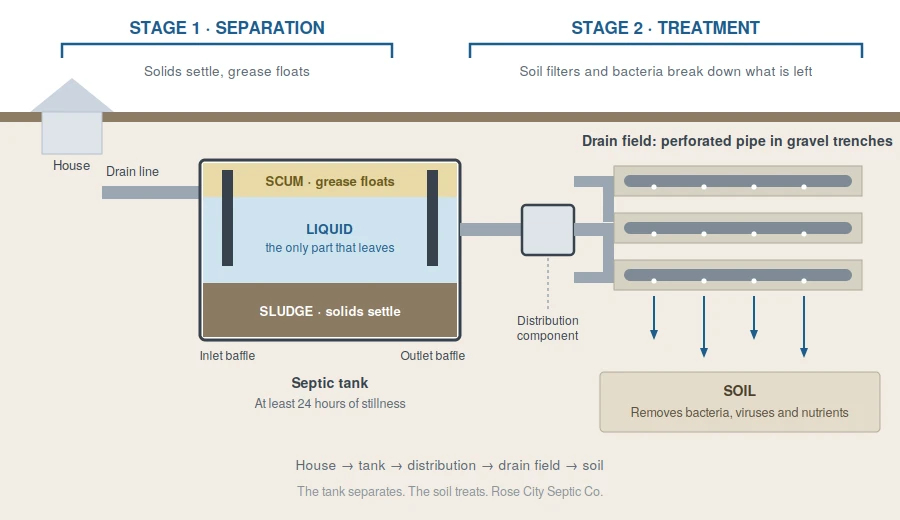
A septic system handles wastewater in two stages. The tank separates it. The soil treats it.
That is the sentence to hold onto, because most people have the second half wrong. The tank gets all the attention, and the tank is really just a settling chamber with a lid. According to the EPA, as wastewater percolates down through the ground below the drain field, the soil is naturally removing harmful coliform bacteria, viruses and nutrients. The dirt is the treatment plant.
This is not a fringe setup, either. More than one in five households in the United States run on a septic or small cluster system. Out here it is closer to the default than the exception.
When I walk a property, those are the two things I am looking at. What shape is the separation stage in, and is the treatment stage still accepting water. Almost every septic problem is one of those two, and telling them apart is most of the job. If you are weighing a system against a city connection rather than trying to understand one you already have, that question is covered in septic system vs. sewer.
Follow one flush, from your drain to the soil
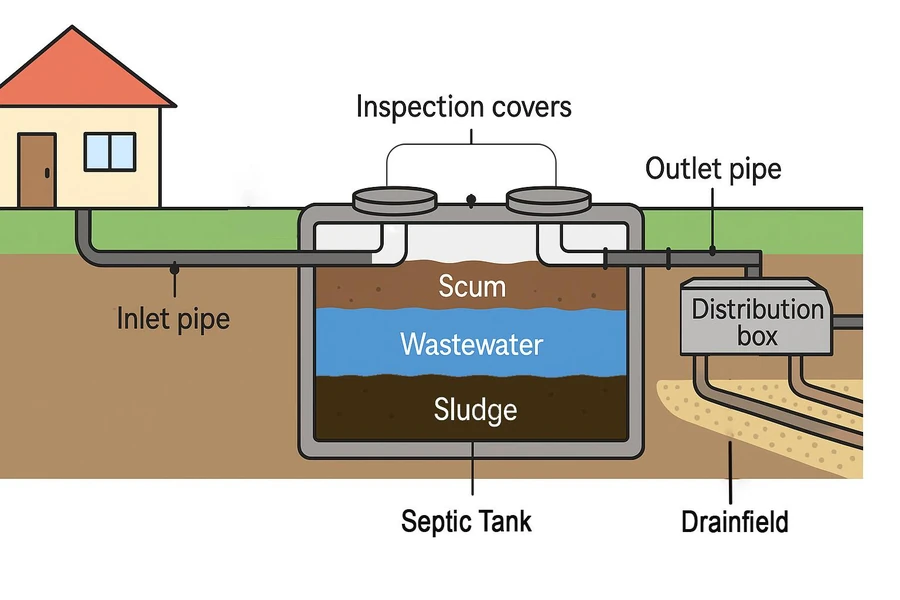
Everything that goes down a drain in the house leaves through one line. Sinks, showers, laundry, toilets, all of it combines and exits through a single main drainage pipe that runs out to the tank. Our work starts where that line leaves the building.
Inside the tank, the water slows down and stops moving. That pause is the entire point, and it is what the next section is about.
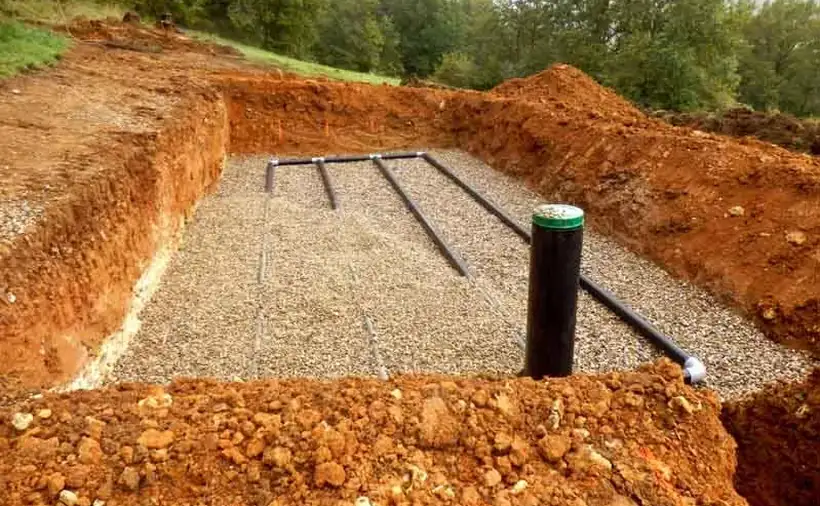
The liquid in the middle of the tank leaves through the outlet, usually into a distribution component that splits the flow between several lines. From there it runs out into the drain field, which is a set of trenches holding perforated pipes bedded in gravel. Water seeps out through the holes, down through the gravel, and into the soil underneath.
That is the whole path. House, tank, distribution, field, soil. When I am diagnosing something, I check it in that order, because the water travels in that order and a problem at any point shows up everywhere downstream of it.
The tank: where separation happens
Give wastewater a day of stillness and it sorts itself into three layers. Solids sink into a sludge layer on the bottom. Grease and oils float into a scum layer on top. Clearer liquid sits in the middle, and that middle band is the only part meant to leave.
What keeps the layers in place is a pair of baffles, one at the inlet and one at the outlet. Penn State Extension puts their job plainly: baffles stop wastewater from short-circuiting across the liquid surface and keep the scum layer and suspended particles from flowing out into the drain field. A baffle is a small part. It is also the part standing between your field and everything floating in that tank.
When I pull a lid, I read four things before I run the hose. How thick the scum layer is. How deep the sludge has built up against the outlet side. Whether both baffles are intact or cracked. And how clear the liquid in the middle actually looks. Those four together tell me more than any service record a homeowner hands me, and they are usually the first time anyone has described the inside of that tank to them.
A tank that has been kept up looks different from one that has not, and the difference is visible without any instruments. Whether the tank is the right size for the house above it is a separate question, worked through in how big of a septic tank does a house need. How often a tank needs emptying depends on the household, and that is worked through in how often should you pump a septic tank. What matters here is why it is done at all, which brings us to the field. Septic tank pumping exists to protect the stage after it.
The drain field: where the water actually gets cleaned
The tank holds and separates. The field is where treatment happens, and the treating is done by the ground.
Effluent leaves the perforated pipes and soaks into the soil below the trench. The soil acts as a filter that traps particles and organic matter, and the bacteria living in that soil break down what is left. Nothing about this requires power, chemicals or moving parts on a conventional system. It requires soil that can accept water at a workable rate, and enough of it.
Which is exactly why the tank matters. When solids get past the baffles and reach the field, they clog pipes and soil and treatment efficiency drops. Once the soil around those trenches plugs up, you are not cleaning it out. That is the part I try to get across at every pump-out, because a tank service is routine work and a failed field is not.
I have opened tanks where the sludge was within a couple of inches of the outlet baffle, and the owner had no idea anything was wrong inside the house yet. That is the window. Everything you can see from indoors shows up later, and those signs are covered in signs your septic tank is full.
Conventional or aerobic: what East Texas clay decides
There are two systems you are realistically choosing between in Smith County.
A conventional system uses gravity to move effluent from the tank to a drain field where soil filters it. An aerobic system uses forced air to treat the wastewater more thoroughly before dispersal, often through spray heads. The EPA describes an aerobic unit as running many of the same processes as a municipal sewage plant, only scaled down, by injecting oxygen into the treatment tank to increase bacterial activity.
What decides between them is the dirt. Texas rules sort soil into texture classes, and the wording is specific. Class II covers sandy loam and loam soils. Class III covers silt and the clay loams. Class IV covers silty clay and clay. The same rules name clay subsoils as restrictive horizons, which means water does not move down through them at a useful rate. A site evaluation is a physical thing, not paperwork. Two borings or two backhoe pits at opposite ends of the proposed field, dug at least 2 feet below the planned trench bottom.
When the result comes back heavy, the consequence is not subtle. As the Angelina and Neches River Authority states it, some soil types such as clay are inadequate for proper absorption and treatment, and therefore a conventional system cannot be installed. Much of East Texas sits on that kind of ground, which is why aerobic systems are common here. Not universal. Plenty of lots in this county test fine for conventional, and the only way to know is to test the specific lot.
Neither type is simply better. Aerobic systems handle soil that conventional systems cannot, and the EPA notes that lifetime maintenance should be expected for them, because they have pumps, diffusers and spray heads that wear. Conventional systems have almost nothing to break and need soil that cooperates. I service both every week, and the tradeoff is consistent: one asks more of the ground, the other asks more of the owner.
That difference shows up in the budget before it shows up anywhere else, which is covered in septic system installation cost in East Texas. The part homeowners get wrong is thinking this is a choice. In most of East Texas, the perc test result and TCEQ rules determine the system type. Budget comes after the soil data. Smith County is blunt about who makes the call: only a registered sanitarian or professional engineer can determine what type of system needs to be installed. I have heard homeowners quoted a system type before anyone put a shovel in their ground. That quote is a guess.
How to tell which system you own
Most people cannot tell me which system they have. That is not an insult to homeowners, it is a gap in what gets handed over at closing, and it matters because the two types need completely different things from you.
Six checks, none of which require calling anyone:
- An electrical control panel mounted on an outside wall, usually a grey or beige box near the meter, points to aerobic. Conventional systems have no panel because they have nothing to control.
- An alarm, either a light or a buzzer, means aerobic. A conventional system has nothing to alarm about.
- A low continuous hum in the yard is the air pump running, which only an aerobic system has.
- Spray heads in the lawn that run at odd hours and are not connected to an irrigation timer are surface application from an aerobic unit.
- The county permit file for the property lists the system type that was approved and installed.
- Chlorine tablets in a tube on the system means aerobic, since conventional systems do not disinfect.
Here is the honest limit on all of that. From the access lid, the tank looks the same either way. That is exactly why this gets missed, and why knowing which system you own is the first piece of information that actually matters. An aerobic system running without a chlorine routine and without scheduled visits is a compliance problem building quietly.
If the property came with no records at all, that is a normal Tuesday out here. I carry a probe rod and a method, and on most lots I have the tank located in about 20 minutes. Older installs and rough yards take longer. A baseline inspection puts the whole thing in writing so the next owner is not guessing the way you had to.
What goes wrong, and where
Failures sort by location, and the location determines the repair.
The line from the house can crack, sag or fill with roots, which is a line problem rather than a system problem. The tank fails at the baffles most often, and a collapsed baffle lets solids move toward the field. The distribution component can settle out of level and send too much flow down one line while the others sit unused. The field fails when the soil stops accepting water, from solids, from saturation, or from age. Aerobic systems add mechanical parts to the list: air pumps, diffusers, float switches and spray heads all wear.
What none of that tells you is which one you have. I get called about tanks that turn out to be fine, and the field was the problem the whole time. Standing in your bathroom, a slow drain from a cracked line, a full tank and a saturated field feel identical. That is why my first move is never to guess and start digging.
What the system needs from you
Not much, and it is specific.
The tank needs emptying on a schedule that comes from what is actually in it rather than a number on a magnet. I have pumped tanks at three years that looked a decade overdue and tanks at five that could have waited. The sludge depth decides, not the calendar.
Aerobic systems carry a legal requirement on top of that. Texas requires the system to be covered by a maintenance contract with a licensed maintenance provider. That provider inspects the components and files a report with the county and the owner at least once every four months.
TCEQ does allow a homeowner to take over maintenance on certain system types two years after installation. Whether that is permitted is the county's call. Some require homeowner training first and others do not allow it at all. The maintenance and the reporting themselves are never optional. Smith County states it directly: if you have a septic or aerobic system, you are required to maintain it and have it inspected.
Beyond that it is what goes in. Grease, wipes, and anything that does not break down all end up as sludge sooner, which shortens the interval and pushes solids toward the field.
Knowing what you own
The system in your yard is not complicated. Water separates in a tank, then soaks into the ground and gets cleaned on the way down. Two stages, and the second one is the one that is expensive to replace.
What most people are missing is not the concept. It is the specifics of their own property: which type they have, where the tank is, what condition it is in, and what the last person to open it actually saw. That is a morning's work to establish and it stays useful for years.
If nobody has ever walked you through your system, or the property came with no records, we can locate the tank, open it and tell you exactly what is there in plain language. Free on-site estimates, and same-day response is typical. Call or text (903) 857-7325, or get in touch here.
Common Questions Answered
Frequently Asked Questions
What are the main parts of a septic system?
A drain line from the house, a septic tank with an inlet and outlet baffle, a distribution component, and a drain field of perforated pipes in gravel trenches. An aerobic system adds an air pump, a treatment chamber, a disinfection device and usually spray heads. The soil beneath the field is a working part of the system even though nobody installs it.
Does the septic tank clean the wastewater?
No. The tank separates solids from liquid and holds them, which is a different job. The cleaning happens in the soil under the drain field, where bacteria and filtration remove bacteria, viruses and nutrients as the water moves down. Everything the tank does is in service of keeping that soil working.
How long does wastewater stay in the septic tank?
At least 24 hours in a correctly sized tank at normal household flow, according to Penn State Extension. That pause is what lets solids settle and grease rise. Heavy water use compresses that window, which is one reason a large household on a small tank runs into trouble sooner.
What is the difference between a conventional and an aerobic system?
A conventional system uses gravity to move effluent from the tank to a drain field where soil filters it. An aerobic system uses forced air to treat the wastewater more thoroughly before dispersal, often through spray heads. In East Texas many properties require aerobic systems because the clay soil does not support the drainage conventional systems need, and the soil evaluation and TCEQ rules determine which one a property can use.
How do I find out which type of system my house has?
Look for a control panel, an alarm, an air pump sound, spray heads or chlorine tablets, all of which mean aerobic. If none of those are present it is likely conventional. The county permit record for the property is the definitive answer, and an inspection settles it for a property with no records.
Do I need a permit for a septic system in Smith County?
Generally yes for properties under 10 acres. Smith County states that qualifying tracts of 10 acres or more meeting specific criteria need no planning materials, permit or inspection, so the acreage and the criteria both matter. Confirm your property's status with the county before assuming either way.
Get Clear Septic Answers Today
Talk with a local team that has served Tyler since 2005. Tell us about your property, and we will help you understand the right next step with a free estimate.
(903) 857-7325Or fill out the form — we'll be in touch shortly.