
Septic Inspections in Tyler, Texas
A septic inspection gives you a clear picture of how your tank, lines, and drain field are performing. It is a practical first step for homeowners who notice changes in their system or want reliable information before making a repair decision.
About This Service
A septic inspection is more than a quick look at the tank lid. It is a focused check of the system components that move wastewater away from your home, including the tank, inlet and outlet areas, visible connections, and drain-field conditions. In Tyler, changing soil conditions, seasonal rain, and everyday household use can affect how well a septic system performs. The goal is simple: give you understandable findings and a sensible path forward before a small concern becomes a disruptive problem.
Slow drains throughout the house, gurgling toilets, sewage odors outdoors, standing water near the field, or unusually green grass above buried lines are all reasons to schedule an inspection. A single slow fixture may be a plumbing issue, but repeated symptoms across several fixtures deserve a closer look. Properties near the Azalea District and along Old Jacksonville Highway can have mature landscaping and established utility areas that make early diagnosis especially valuable. Waiting for a backup can create more cleanup, more stress, and fewer options for repair.
Our visit begins with a conversation about what you have noticed, when the system was last serviced, and where the trouble seems to be occurring. We locate accessible components, examine the tank area and surrounding ground, and look for evidence of restricted flow, leaks, or drain-field saturation. When conditions allow, we also assess how wastewater is moving through the system. You receive plain-language findings rather than confusing jargon, along with recommendations that fit the condition of your system.
- Check accessible tank and line components
- Identify visible drainage and saturation concerns
- Review symptoms and recent system history
- Explain practical next steps clearly
A thorough inspection can confirm that a system is operating normally, identify maintenance that should be scheduled, or narrow down the cause of a developing failure. Some concerns can be addressed with routine service or a targeted repair, while others require more detailed planning. The timeframe depends on access, weather, and the symptoms being investigated, but the inspection itself is designed to provide useful direction without unnecessary delay. You leave with a clearer understanding of what is happening underground and what deserves attention next.
Since 2005, Rose City Septic Co. has helped local families make informed decisions about their septic systems. We bring practical field experience, clear communication, and respect for your yard to every appointment. From homes near Bergfeld Park to properties closer to Lake Tyler, we understand that each site has its own layout, soil, and service history. If your system is sending warning signs or you simply want reassurance about its condition, schedule a septic inspection today.
Real Estate Inspections and the Smith County Record
A septic inspection before closing is the cheapest insurance available on an East Texas property, and it answers a question the seller often genuinely cannot: what is actually in the ground and is it on the county's books.
A lot of Smith County property carries systems installed under earlier rules, systems altered without a permit, and on tracts of ten acres or more, systems that were legally never permitted at all under the 30 TAC 285.3 exemption. None of those are automatically bad. All of them mean there may be no county file describing what you are buying, and a lender or a future buyer will ask.
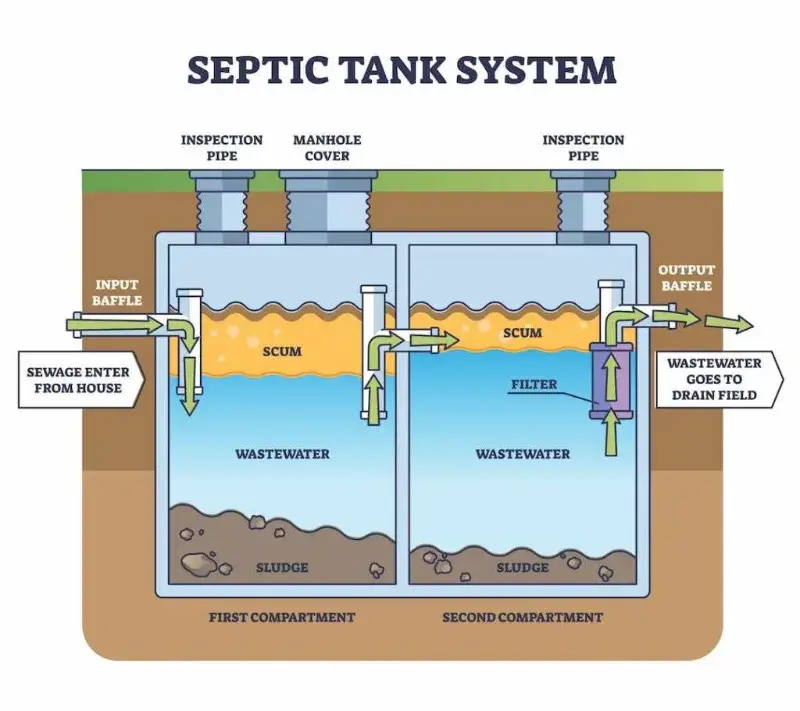
The inspection establishes system type and capacity against the number of bedrooms, locates and opens the tank, checks the inlet, outlet and baffle, evaluates the disposal area, and on aerobic systems verifies the unit runs and that a current maintenance contract exists. That contract is a live compliance obligation that transfers with the property.
The finding that matters most on a Tyler-area purchase is capacity. A system sized for a three-bedroom house that is now marketed as four bedrooms is a system that will fail under the new owner, and that is a price negotiation while the contract is open and an unpleasant surprise afterwards.
What the Ground Tells an Inspector Around Tyler
Half of a good septic inspection happens outdoors, and in East Texas the ground is unusually informative.
Time of year changes what you can see. The clay-rich Bowie and Kirvin subsoils across Smith County perch water above them in winter and early spring, so a marginal absorption field that looks perfect in August can be surfacing in February. An inspection in dry conditions has to account for what the wet season will do, which means reading the soil profile and the field sizing rather than only looking at the surface.
Vegetation is a tell. An unnaturally green, fast-growing strip over the drain field says effluent is reaching the surface layer. Standing water or soft ground over the absorption area after rain says the same thing more loudly.
Placement is checked against the setbacks: distance from the property lines, from any well, from structures, and on Flint and Lake Palestine properties from surface water. A system that was compliant when installed can be non-compliant now because a well, a shop or a fence went in afterwards.
And we look for what should not be there — vehicles parking on the field, a shed built over it, livestock crossing it, roof or driveway drainage directed across it. Each of those shortens the life of the system and each is worth knowing before you own it.
Septic Inspection Before You Buy in Smith County
A septic inspection is the cheapest insurance available on an East Texas property purchase, and it answers a question the seller often genuinely cannot: what is actually in the ground, and is it on the county's books. A lot of Smith County property carries systems installed under earlier rules, systems altered without a permit, and on ten-acre-plus tracts systems that were legally never permitted at all.
When buyers search septic inspection near me around Tyler, they are usually inside an option period with days rather than weeks to work with. We schedule around that, because the finding only has value while the price is still open. Rose City Septic Co. inspects across Tyler, Whitehouse, Bullard, Flint, Lindale, Chandler, Jacksonville and Kilgore.
Septic inspection cost is modest against what it protects. The finding that matters most on a Tyler-area purchase is capacity: a system sized for a three-bedroom house that is now marketed as four bedrooms will fail under the new owner, and that is a negotiation while the contract is live and an unpleasant surprise afterwards.
On an aerobic system the inspection also verifies that a current maintenance contract exists, because that obligation transfers with the property. A gap in the report history is a live compliance question, not a paperwork detail.
How the Job Actually Runs, Step by Step
No surprises is mostly a matter of telling you the order things happen in before they happen. This is how a job runs from your first call to the day it is signed off.
- You call, we ask what the system is doingSymptoms, last service date, system type and access. It tells us what to bring on the truck.
- We schedule around your property, not a route sheetBecause we work Tyler and the surrounding towns daily, most visits land within days rather than weeks.
- Lids located and openedOn properties with no risers this is the part that takes the time. We find them rather than guessing.
- The work itselfDone properly and completely, with both compartments and every component covered rather than the quick version.
- Inspection while the lid is offInlet, outlet baffle, effluent filter and the disposal area walked. This is included, not billed as an extra.
- You get told where the system standsIncluding when the honest answer is that nothing needs doing for another few years.
Why Rose City Septic Co.
- Working East Texas since 2005Two decades on Smith County ground. The soil behaviour described on this page is not research, it is what we dig through.
- We run the county process weeklySite evaluation, planning materials, permit to construct, final inspection. An installer who files these constantly moves them faster than one who does not.
- Diagnosis before the quote, every timeWe do not price a system or a repair over the phone. The boring log or the open tank decides the number, and we would rather lose the job than guess at it.
- Licensed for aerobic maintenance reportingTexas requires aerobic units to be under contract with a licensed maintenance provider filing reports at least every four months. We can hold that contract rather than leaving you to find someone who can.
- County-inspected, on the recordWork that alters a system gets permitted and inspected, so what you own is documented. That matters at resale far more than it does on the day.
- Local for realTyler, Whitehouse, Bullard, Flint, Lindale, Chandler, Jacksonville and Kilgore are the roads we work daily — not a service radius drawn on a map from another city.
What an Inspection Has to Cover Under Texas Rules
Septic inspections in Texas sit against 30 TAC Chapter 285, and locally against the rules administered by Smith County Environmental Health. A real inspection is not a walk around the yard. It means opening the tank, checking both compartments, verifying the inlet and outlet baffles and the effluent filter, measuring sludge and scum depths, checking the distribution component and walking the disposal area for surfacing, odour, soggy ground and unusually vigorous grass.
For a property transaction there is a second half to it, which is the paper trail. Does the system have a permit on file with the county, does the permitted design match what is actually in the ground, and has a bedroom been added since without the system being re-sized. Systems installed before local permitting, or modified informally over the years, turn up constantly on rural Smith County tracts and are far cheaper to discover before closing than after.
On an aerobic unit the inspection also covers compliance items that carry their own obligation. An active maintenance contract with a licensed provider under 285.7, chlorine present in the tablet chamber, functioning aerator and spray heads, and a wetted area that stays on the owner's property.
You get the findings in writing, with what is failing now, what will fail next, and what is simply old but working. No pressure to buy a system on the spot.
The Season You Inspect In Changes What You See
Timing genuinely affects a septic inspection in East Texas. Inspect during the wet months from late autumn through May and you see the system under load, with the ground saturated and a perched water table sitting on the clay subsoil. Surfacing, soggy ground and slow drainage are visible. Inspect the same property in a dry August and a field that fails every winter can present as sound.
This is the trap in property transactions. A summer closing on a rural Smith County tract can hand a buyer a system that looks fine and fails in its first February. It is not that the inspection was careless, it is that a dry-season inspection has to work harder, which means reading sludge and scum depths carefully, looking for staining and historic surfacing marks, checking the biomat condition where it can be reached, and taking the household's actual water use seriously rather than assuming design flow.
Drought has its own tells. Shrinking clay separates joints and cracks lids, and that damage is easiest to spot while the ground is still open and pulled back.
We note the conditions the inspection was carried out in as part of the report, because a finding without the season attached to it is worth less than it looks.
Your Questions, Answered
Frequently Asked Questions
These answers address common septic questions from Tyler-area customers. Every property is different, so a direct conversation is the best way to apply this information to your system.
What does a septic inspection include in Tyler?
A septic inspection typically reviews accessible tank components, visible line connections, drainage patterns, and the condition of the ground around the drain field. We also discuss symptoms such as slow drains, odors, or wet areas so the assessment matches what you are experiencing. The exact scope depends on access to the system and the reason for the visit. You will receive clear findings and recommendations based on the conditions observed.
How long does a septic inspection take?
Many inspections can be completed in one visit, although the timing varies with tank access, weather, and the complexity of the symptoms. A property with clear access and a known tank location usually takes less coordination than a site with buried components or uncertain records. Heavy rain can also affect ground conditions and what can be evaluated that day. We will let you know what to expect before the appointment.
Should I get an inspection if my septic system seems fine?
Yes, an inspection can be useful even when there is no obvious backup or odor. Septic problems often develop gradually below ground, where warning signs are easy to miss until wastewater has nowhere to go. Routine checks help you understand the system's condition and plan maintenance around your schedule. They can also be valuable before major landscaping, a home sale, or changes in household use.
How much does a septic inspection cost in Tyler, TX?
Septic inspection cost is modest relative to what it protects, and it varies mainly with whether the tank lids have to be located and dug to. Replacing a system on a lot constrained by well and setback limits is not a small line item, so the inspection is priced as insurance against exactly that. We confirm the figure before scheduling.
Can you do a septic inspection near me during my option period?
Yes, and that is when it should happen. We inspect across Tyler, Whitehouse, Bullard, Flint, Lindale, Chandler, Jacksonville and Kilgore, and we work around option-period deadlines because the finding is only worth something while the price is still negotiable.
What does a septic inspection actually check?
System type and capacity against the bedroom count, the tank located and opened, inlet, outlet and baffle condition, the disposal area evaluated for soft ground and surfacing, setbacks from the property lines, any well, structures and surface water, and on aerobic systems whether the unit runs and a current maintenance contract is in place.
The property is on ten acres and has no septic permit on file. Is that a problem?
Not necessarily. Under 30 TAC 285.3, a single-family home on ten acres or more can be legally exempt from permitting where the system keeps 100 feet from every property line and creates no nuisance. What it does mean is that there is no county file describing what you are buying, so the inspection is the only way to establish what is in the ground.
Get Clear Septic Answers Today
Talk with a local team that has served Tyler since 2005. Tell us about your property, and we will help you understand the right next step with a free estimate.
(903) 857-7325Or fill out the form — we'll be in touch shortly.