
How often should you pump a septic tank? Tank size and household size charts
Most septic tanks need pumping every 3 to 5 years, but tank size and household size move that number a lot. Charts, East Texas soil factors, and what the sludge depth actually shows.
TL;DR
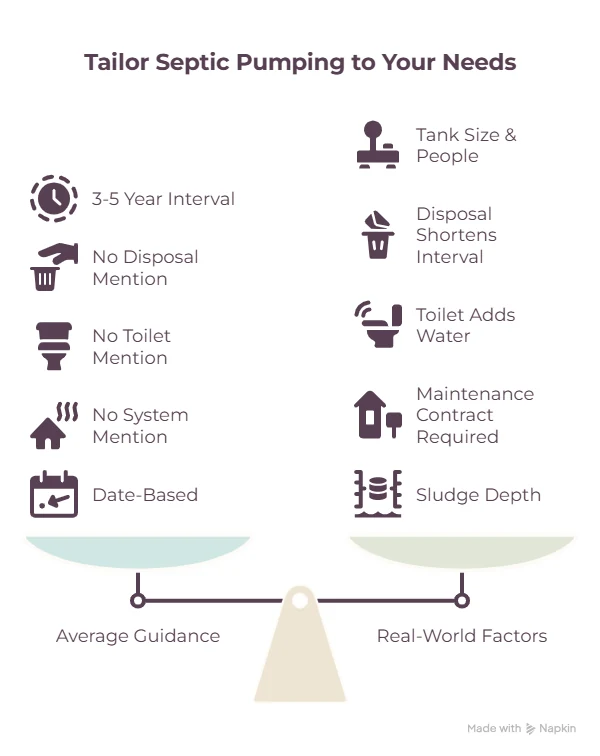
- The common guidance is to pump every 3 to 5 years, but that range assumes an average tank and an average household, and most homes are one or the other, not both.
- Tank size divided by the number of people using it sets your real interval. A 1,000-gallon tank serving four people needs pumping around every 2.6 years, while the same tank serving two people can go closer to 5.9 years.
- A garbage disposal shortens the interval by 1 to 2 years, and a running toilet can add 200 gallons of water a day to the system.
- Aerobic systems in Texas carry a state-required maintenance contract on top of pumping, and that requirement is not optional.
- The sludge depth at the outlet baffle is the only number that settles the question, which is why the pump-out report matters more than the date on the calendar.
A new owner near Chandler called me after buying a rural property. The seller had told her the tank was in good shape and had been serviced recently. No paperwork existed, and she had no map showing where the tank was. I probed the yard, found the lid in about 15 minutes, and pulled it. The sludge was within 2 inches of the outlet baffle. Another six months and solids would have been moving into the drain field, and that repair is a different conversation entirely.
Nothing on a calendar would have told her that. The tank told her.
The 3 to 5 year rule is where you start, not where you land
The EPA recommends that a conventional household system be inspected at least every three years and pumped typically every 3 to 5 years. The TCEQ, which is the Texas Commission on Environmental Quality and the agency that regulates septic systems in this state, gives the same range.
That range is a planning number. It is not a diagnosis.
The EPA names four things that move it: how many people are in the household, how much wastewater they generate, how many solids are in that wastewater, and how big the tank is. Change any one of those and the interval changes with it.
I have pumped tanks on a 3-year schedule that looked like nobody had touched them in a decade. I have also pumped tanks at 5 years that had another two years of room in them, and told the owner to call me back later. The schedule should come from what the tank shows, not from a default number on a refrigerator magnet.
What size septic tank you probably have
Before the frequency question means anything, you need your tank size. Texas sets minimum capacities by the size of the house, and most homes were installed at or near that minimum:
| Bedrooms | House size | Minimum tank |
|---|---|---|
| 1 to 2 | Under 1,500 sq ft | 750 gallons |
| 3 | Under 2,500 sq ft | 1,000 gallons |
| 4 | Under 3,500 sq ft | 1,250 gallons |
| 5 to 6 | Larger | 1,250 to 1,315 gallons |
So a three-bedroom house in Tyler is most likely sitting on a 1,000-gallon tank unless someone specifically upsized it.
How to confirm your tank size without guessing
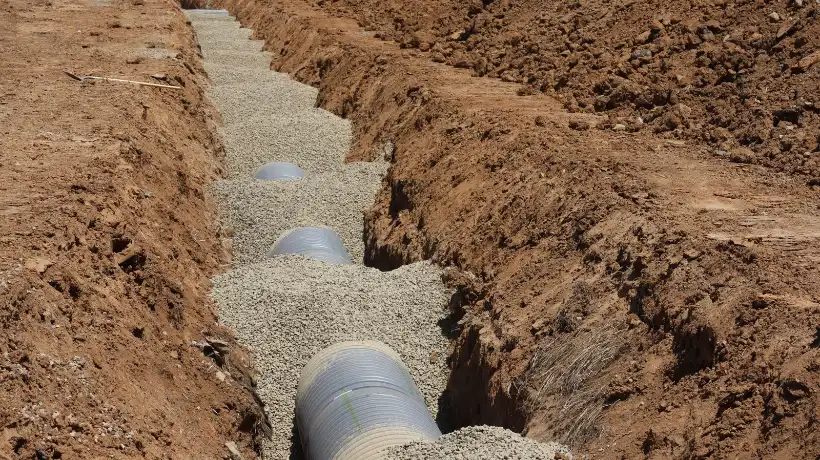
Three places to look. The permit record at the county permitting office, which is the most reliable. The stamp or plate on the tank lid itself, if the lid is accessible. Or the report from the last pump-out, if one exists.
I have been on plenty of properties where the owner did not know whether they had a conventional system or an aerobic one. From the access lid, the two can look similar. The maintenance requirements are completely different. Knowing which system you own and how big it is, is the first piece of information that matters, and a septic inspection is how you get both when there are no records.
Septic tank pumping frequency chart by tank size and household size
This is the part most articles skip. Below is the estimated number of years between pump-outs for a year-round residence, from an extension chart published by Ohio State University Extension. Oklahoma State Extension publishes a separate table built independently, and the numbers land in the same place, so this is not one source's guess.
| Tank size | 1 person | 2 people | 3 people | 4 people | 5 people | 6 people |
|---|---|---|---|---|---|---|
| 750 gallons | 9.1 | 4.2 | 2.6 | 1.8 | 1.3 | 1.0 |
| 1,000 gallons | 12.4 | 5.9 | 3.7 | 2.6 | 2.0 | 1.5 |
| 1,500 gallons | 18.9 | 9.1 | 5.9 | 4.2 | 3.3 | 2.6 |
| 2,000 gallons | 25.4 | 12.4 | 8.0 | 5.9 | 4.5 | 3.7 |
Each of the three most common tank sizes has its own breakdown, because what moves your number depends a lot on which one you have:
- How often should a 1,000-gallon septic tank be pumped? [SPOKE-1000-URL] The Texas minimum for a three-bedroom house, and the tank under most homes in Tyler.
- How often should a 1,500-gallon septic tank be pumped? [SPOKE-1500-URL] What the extra capacity actually buys, and where it stops helping.
- How often should a 2,000-gallon septic tank be pumped? [SPOKE-2000-URL] Long intervals, and the records problem they create.
How to read the chart
Find your tank size in the left column, then move across to the number of people living in the house full time. That number is your baseline interval in years, before any of the adjustments in the next section.
Notice what happens along a single row. On a 1,000-gallon tank, going from two people to four people cuts the interval from 5.9 years to 2.6 years. You did not change the tank. You doubled the load.
Notice what happens down a single column. Four people on a 1,000-gallon tank get 2.6 years. The same four people on a 1,500-gallon tank get 4.2 years. Tank size buys you time, but it buys less than people expect.
Why the numbers work out this way
The math behind every row is the same. One adult produces roughly 90 gallons of solids a year, which bacteria reduce to about 60 gallons. A tank only offers a fraction of its stated volume as usable sludge storage, because the rest is working liquid that has to stay in place for wastewater to settle properly.
So the interval is storage capacity divided by how fast solids arrive. Capacity is fixed the day the tank goes in the ground. Arrival rate is set by the people in the house, and that is the variable you actually control.
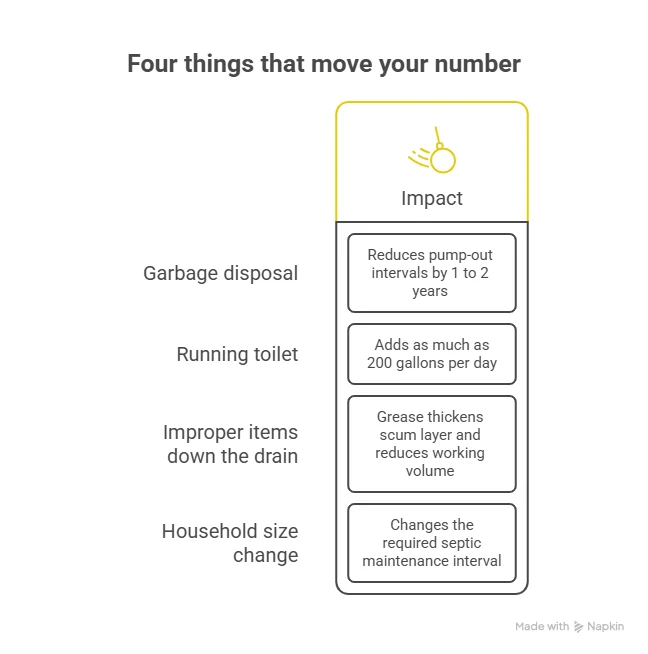
Four things that move your number
A garbage disposal costs you 1 to 2 years
This is the single biggest adjustment on the list. Texas A&M AgriLife states that garbage disposals reduce pump-out intervals by 1 to 2 years. A disposal grinds food solids fine enough to go down the drain, but fine solids still settle in the tank. They just settle faster and in greater volume.
Of these four, the disposal is the one that surprises people most. It is also the only one they chose.
Four people on a 1,000-gallon tank with a disposal are not on a 2.6 year schedule. They are closer to 1.5.
Water volume, and what one running toilet does
More water through the tank means less settling time, which means more solids carried toward the field. The EPA puts average indoor use at up to 70 gallons per person per day, and notes that a single running toilet can add as much as 200 gallons per day on its own.
A toilet that has been running quietly for a month has put roughly 6,000 gallons through a tank that was sized for a fraction of that.
What goes down the drain that should not
The EPA is direct about this: only human waste and toilet paper belong in the toilet. Things that should never go into a septic system include grease and cooking oils, wipes of any kind including the ones labeled flushable, coffee grounds, cat litter, paper towels, and household chemicals or drain cleaners.
Grease is the one that shows up most often at the pump-out. It floats, thickens the scum layer, and eats the working volume of the tank from the top down while sludge eats it from the bottom up.
The household that changed size
Septic intervals are set by who is actually using the system, not by who was living there when the system was installed. A retired couple in a four-bedroom house is on a long interval. The same house sold to a family of five is on a short one, and nobody updates the schedule at closing.
The same applies to a house that took in a family member, a rental with more occupants than the listing suggested, or a lake property that runs light most of the year and heavy every summer.
The sludge depth beats the calendar every time
Every one of the numbers above is an estimate. The tank itself is not.
When we pump, I read the tank before anything else. I have been doing this in Smith County for 21 years, somewhere north of 4,000 pump-outs by my own rough count, and I work through it in the same order every time. The scum layer first. Then the sludge depth. Then the condition of the inlet and outlet baffles. Then the clarity of the effluent on the outlet side. Each one tells a different part of the story.
The rule of thumb from Oklahoma State Extension is that a tank should be pumped once the sludge layer reaches 25 to 33 percent of the liquid capacity, measured in the vicinity of the outlet baffle. The outlet baffle is the fitting that holds back floating scum and lets clarified liquid pass on to the drain field. Once sludge climbs to it, solids start going where solids were never supposed to go.
That is the number the Chandler tank was 2 inches away from.
This is also why the report matters as much as the pump-out itself. A tank that comes up nearly clean at 3 years earns a longer interval next time. A tank that comes up loaded at 3 years earns a shorter one. If a contractor pumps your tank and cannot tell you what the sludge depth was, you paid for a service and got no information out of it.
I will not tell an owner the tank is fine when it is not. I have seen tanks that a previous contractor called acceptable, and I did not agree. The repair that comes from ignoring a baffle that needed replacing costs more and disrupts more than the straight answer would have.
What East Texas clay does to your schedule
Clay does not change how fast your tank fills. It changes how expensive it is when you let the tank overflow into the field.
I have pumped tanks in sand country and tanks in Smith County clay. The tank behaves the same. The ground underneath it does not.
Texas classifies soil into five categories, Ia through IV, based on how quickly water moves through it. Sand moves water fastest, silt is in the middle, and clay is the slowest. AgriLife states it plainly: a standard drain field cannot be used in clay soil, because clay simply does not transmit water at the rate a conventional field needs.
Smith County, Cherokee County and Henderson County are heavy clay country. That is why perc tests here frequently come back Class III or Class IV, and why so many properties around Tyler, Flint, Whitehouse and Chandler are on aerobic systems rather than conventional ones. The TCEQ says the same thing at the state level: most soils in Texas cannot properly absorb pollutants on their own, so alternative treatment methods are required.
Here is the practical consequence for your pumping schedule. In sandy soil, a field that takes on some solids has a fighting chance of recovering. In East Texas clay, a field that takes on solids has almost nowhere to send them, and it saturates. That turns a missed pump-out into a drain field repair, which is a different scope of work and a different bill.
Aerobic systems run on a different schedule
An aerobic system still has a tank, and that tank still needs pumping. But pumping is only part of what an aerobic system requires.
Texas requires a maintenance contract on every aerobic system. This is a state requirement, not a service add-on. Under TCEQ rules, a licensed maintenance provider must submit reports at least once every four months, which can extend to six months on systems with electronic monitoring. In practice most contracts run quarterly visits. Letting the contract lapse creates a compliance violation.
What happens on those visits is the part most owners never get explained. Chlorine level check, spray head inspection and adjustment, air pump operation, alarm test, and a dissolved oxygen reading in the aeration chamber.
That last one matters more than it sounds. On a quarterly visit near Lake Tyler, everything looked right from above. No alarm history, chlorine where it should be, control panel normal. I checked dissolved oxygen anyway because it is a standard step, not a reaction to something looking off, and the levels came back low for the tank volume. I pulled the air diffuser and found a hairline crack running down one side. Air was bypassing the water column instead of bubbling through it, so treatment efficiency was dropping with no visible sign and no alarm. I replaced the diffuser, and oxygen was back to proper levels by the next visit. The homeowner had no idea anything was wrong.
The alarm catches a system that stopped working. The aerobic maintenance contract visit catches one that is on its way there.
What it costs to run past the interval
The EPA puts routine septic maintenance at $250 to $500 every 3 to 5 years nationally, and the cost of a failed conventional system at $5,000 to $15,000, with alternative systems running higher. Those are national figures, not our prices, and local conditions move them.
The expensive calls I go on are almost never about the tank. They are about what the tank was allowed to send downstream.
The gap between those two numbers is the whole argument for staying on schedule.
The mechanism is worth understanding, because a full tank by itself is not the expensive failure. A tank that is pumped before it overflows protects the drain field. A tank that overflows sends solids into the field, which is a far more expensive repair. The tank is a serviceable component. The field is not, at least not in the same way.
The EPA also puts drain field service life at 25 to 30 years under normal conditions. Solids reaching the field do not shorten that gently.
Signs you are already past due
Slow drains, gurgling fixtures, sewage odors, wet or unusually green ground near the system, and backups are the standard list. The problem with the standard list is that it does not tell you what to do next, because a tank concern and a drain field concern produce nearly identical symptoms inside the house.
Here is the sorting rule we use. Pull the lid first. If the liquid level in the tank is normal and the outlet side looks clear, the tank is not your problem and pumping it will not fix anything. The issue is downstream, in the field or the distribution components.
If the level is high, the sludge is deep, or the outlet is obstructed, the tank is the problem and pumping is the answer.
This is why I do not recommend pumping over the phone based on symptoms. I have been on properties where the owner called about a full tank, the tank was fine, and the actual issue was a saturation zone in the field caused by roof drainage running toward the field perimeter. Rerouting the downspouts fixed it. No excavation, no pumping.
What happens at a pump-out and what you should get from it
Knowing what the service covers helps you ask better questions of whoever you hire.
Locating the tank is part of the job, not an add-on. On most lots it takes me about 20 minutes with a probe rod.
Included in a septic tank pump-out with us:
- Locating the tank access if it is not already known, which on most lots takes me about 20 minutes with a probe rod.
- Pumping the accumulated solids and scum out of the tank.
- Visual inspection of the baffles and tank walls while the tank is empty and visible.
- A report on tank condition and a recommended next pump date based on what was actually in there.
Not included, and worth knowing before you book:
- Drain field evaluation, which is a separate service because it is a different assessment.
- Tank repair, which is quoted separately if damage is found.
- Replacement of damaged baffles, which can be quoted at the time of pumping if needed.
The reporting item is the one that pays for itself. It is what turns your next interval from a guess into a number.
Getting a real number for your property
If you know your tank size and your household size, the chart above gives you a working interval today. If you bought the property and inherited no records, or the last pump date is somebody's recollection rather than a document, the chart is a starting point and the sludge depth is the answer.
Give me the tank size and the headcount and you have a date to plan around. Give me a sludge reading and you have the real one.
That is what a pump-out and condition report gives you: a baseline, a number, and a date you can plan around instead of a range you hope covers you.
Rose City Septic Co. has served Tyler since 2005, and we cover Whitehouse, Bullard, Flint, Lindale, Chandler, Jacksonville and Kilgore. Call or text (903) 857-7325 with your property location and whatever system history you have, or get a free estimate online. Response is usually same day, and on-site estimates are free.
Sources
- US EPA — Septic Systems (Decentralized / Onsite Systems)
- TCEQ — On-Site Sewage Facility Maintenance Requirements
- Texas A&M AgriLife Extension — garbage disposals and pump-out intervals
- Ohio State University Extension (Ohioline) — septic pumping interval tables
- Oklahoma State University Extension — septic tank pumping frequency tables
Common Questions Answered
Frequently Asked Questions
How often should a 1,000-gallon septic tank be pumped?
Roughly every 3.7 years for three people and 2.6 years for four. It is the Texas minimum for a three-bedroom house, so it is the most common tank around Tyler, and it has the least margin of any size in the chart. Full breakdown here: how often to pump a 1,000-gallon tank [SPOKE-1000-URL].
How often should a 1,500-gallon septic tank be pumped?
About 5.9 years for three people and 4.2 years for four. The extra 500 gallons adds roughly 19 months for a family of four, not double the time. Full breakdown here: how often to pump a 1,500-gallon tank [SPOKE-1500-URL].
How often should a 2,000-gallon septic tank be pumped?
About 8 years for three people and 5.9 years for four. On an interval that long the risk shifts from the tank to the record keeping. Full breakdown here: how often to pump a 2,000-gallon tank [SPOKE-2000-URL].
Can a septic tank go 20 years without being pumped?
The tables show 25.4 years only for a single person on a 2,000-gallon tank, which is a rare situation. For anything resembling a normal household, no. The Chandler tank had gone 14 years and the sludge was within 2 inches of the outlet baffle, which means it was months away from pushing solids into the field, not years.
Does a bigger tank mean I can skip pumping?
No. A bigger tank holds more sludge before it becomes a problem, which buys time. It does not process solids any faster. The accumulation rate is set by the people using the system, not by the tank.
Do septic additives replace pumping?
No. Additives do not remove sludge from the tank. Only pumping removes sludge from the tank. Whatever a product does to the biology, the solids that settle to the bottom are still sitting there, and the outlet baffle does not care what brand of treatment went down the drain.
How often does an aerobic system need service in Texas?
Maintenance reporting is required at least once every four months under TCEQ rules, extendable to six months with electronic monitoring, and quarterly is the common contract structure. That is separate from pumping the tank, which the aerobic system still needs on its own schedule.
Get Clear Septic Answers Today
Talk with a local team that has served Tyler since 2005. Tell us about your property, and we will help you understand the right next step with a free estimate.
(903) 857-7325Or fill out the form — we'll be in touch shortly.