
Septic system vs. sewer: which is better for a home?
An even comparison on cost, maintenance and control, and the question that decides it for most East Texas properties.
TL;DR
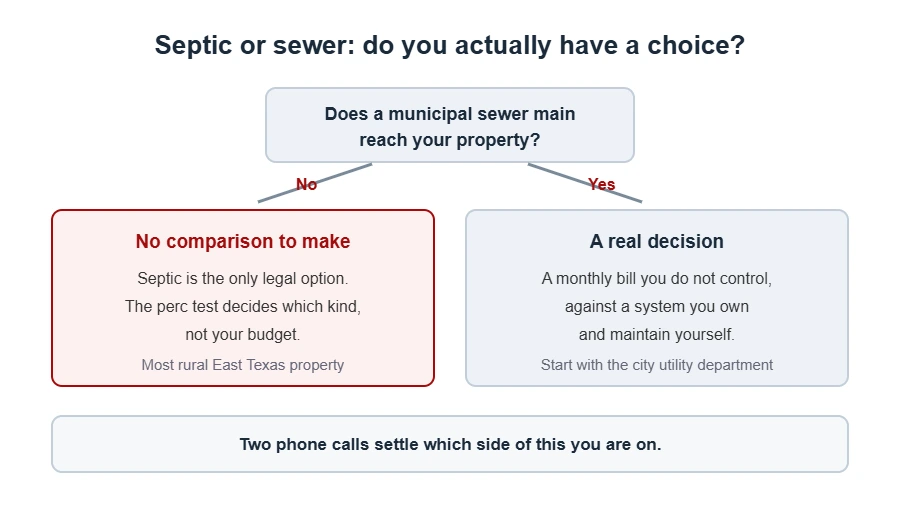
- Most people asking this question do not have a decision to make, because no municipal line reaches the property. Finding that out takes one phone call and saves you the whole comparison.
- Sewer genuinely wins on maintenance burden. Somebody else owns the treatment problem, and when a main fails it is the utility's crew rather than your yard.
- Septic wins on no monthly bill and no exposure to rate increases you do not control. Federal figures show combined water and wastewater bills climbing steadily.
- In East Texas the septic option often means an aerobic system because of clay soil, which costs more than the national comparisons assume.
- Being on septic is not a liability. Being on septic with no records is, and that gap is fixable.
Most people who ask me whether septic or sewer is better do not have a decision in front of them. They just have not found that out yet.
If no municipal line reaches the property, there is nothing to compare. Septic is the only legal option, and the question becomes which kind, which the soil decides rather than the budget. If a line does reach the property, then the comparison is real and worth working through.
So this splits into two posts, and the first job is figuring out which one you are reading. Worth saying up front: more than one in five households in the United States are on septic or a small community system, so whichever branch you land on, you are in ordinary company.
The question to answer first
Two phone calls settle it, and I would make both before reading another word of comparison.
Call the city utility department and ask whether a sewer main serves your address, and if so, what a connection would involve. Distance from the house to the main is usually what decides whether the answer is practical or theoretical.
Call the county permitting office and ask what the property is currently permitted for. That tells you what is already there on paper, which matters more than what a previous owner told you.
To be clear about our own part in this: we do not do city sewer connection work. If a line is available and you want to know what hooking up would cost and involve, that conversation belongs with the city and a licensed plumber, not with us. What we can tell you is what the septic side of the decision actually looks like.
If the answer comes back that there is no line, skip to the East Texas section. The rest of the comparison is academic for you.
Septic and sewer compared, honestly
| Septic | Sewer | |
|---|---|---|
| Upfront cost | System installation, paid once by the owner | Connection fee plus the run from the house to the main |
| Ongoing cost | Pumping every 3 to 5 years, plus a maintenance contract if the system is aerobic | Monthly bill set by the utility |
| Who is responsible | You | The utility, past your connection point |
| When it fails | Your yard, your bill | Usually the utility's problem |
| Control | You decide when work happens | Rates change without your input |
| Suits | Lower-density and rural properties | Denser areas with infrastructure already in the ground |
Two rows in that table do the real work, and they point in opposite directions. Who is responsible, and control. Everything else is detail hanging off those two.
When customers talk this through with me, those are the two they end up arguing about. Nobody changes their mind over the upfront cost.
Where sewer genuinely wins
I sell septic service and I am still going to say this plainly, because a comparison that never concedes anything is not a comparison.
On sewer, the treatment problem belongs to somebody else. There is no pumping schedule to keep. No drain field to keep vehicles off. No site evaluation, no permit, no maintenance contract. When a main backs up, it is the utility's crew and the utility's budget.
Now the same list from the other side. The EPA recommends a conventional septic system be inspected at least every three years and pumped typically every 3 to 5. It puts drain field service life at 25 to 30 years under normal conditions, and that field is yours. Pumps and controls run 10 to 20 years. Concrete tanks last 50 years or more, which is the good news in that list.
None of that is difficult. But it is yours, permanently, and a sewer customer never thinks about any of it. If what you want is to not think about wastewater, sewer is the better arrangement and I am not going to pretend otherwise.
Where septic wins
No monthly bill, and no exposure to rate decisions made by people you did not elect.
That second part is the one worth backing with numbers rather than asserting. The EPA's Water Affordability Needs Assessment, a report to Congress, cites American Water Works Association data showing combined monthly water and wastewater bills rising from $79.39 in 2017 to $95.02 in 2023 at 6,200 gallons of monthly use. The same report cites the National Association of Clean Water Agencies projecting wastewater rates rising 4 percent a year from 2022 through 2026, and Consumer Price Index data showing water, sewer and trash services nearly tripling between 1998 and 2024, climbing at more than twice the overall consumer price rate.
Those are national figures and your local utility may run above or below them. The direction is the point.
Here is the honest counterweight, in the same section rather than buried further down. Septic has no monthly bill, but it has an ownership cost and a failure exposure. The EPA puts routine septic maintenance at $250 to $500 every 3 to 5 years nationally, and a failed conventional system at $5,000 to $15,000, with alternative systems running higher. Those are national figures too, not our pricing, and we do not publish pricing.
So the trade is not free money against a bill. It is a predictable monthly charge you do not control against an irregular cost you do control, plus a risk you carry yourself. Which of those you prefer is a genuine matter of temperament, and I have customers on both sides of it.
The part you can influence is the risk. A tank on a known schedule with a documented condition report is a very different exposure from a tank nobody has looked in since the house was built, and pumping on the right interval is most of what separates the two.
Why rural properties are on septic in the first place
This is not an accident of history or a gap waiting to be filled.
The EPA states that the total per-connection cost of a decentralized system will be lower than the equivalent conventional gravity sewer system for the same service area, while noting the size of that difference depends on land costs, topography, presence of shallow rock and lot density.
Read that last part again, because it explains the roads around Tyler. Running a main across low-density acreage costs a great deal per house served. The further apart the houses, the worse the arithmetic gets. That is why the line stops where it stops, and it is why a five-acre lot 20 minutes outside town is not waiting for infrastructure. It is on the arrangement that suits it.
I have been working these counties for 21 years and I have watched service areas expand at the edges. What I have not seen is a line pushed out to serve scattered rural lots, because the numbers do not support it.
What the East Texas answer actually looks like
Here is where the national comparison stops being useful for a Tyler-area property.
Texas classifies soil into categories Ia through IV based on how fast water moves through it. Sand moves water fastest, silt sits in the middle, clay is slowest. Texas A&M AgriLife states it directly: a standard drain field cannot be used in clay soil, because clay does not transmit water at the rate a conventional field needs.
Smith, Cherokee and Henderson counties are heavy clay. The TCEQ says the same thing at state level: most soils in Texas cannot properly absorb pollutants on their own, so alternative treatment methods are required.
The practical consequence is that on a lot of properties around Tyler, Flint, Whitehouse and Chandler, choosing septic means an aerobic system rather than a conventional one. That changes the septic side of the ledger in two ways. It costs more to install, because there are more components. And it carries a maintenance contract that Texas requires by law, with a licensed provider submitting reports at least once every four months, extending to six on systems with electronic monitoring. Most contracts run quarterly visits. Letting one lapse creates a compliance violation.
That contract is not optional and it is not an upsell. It is part of the true cost of the septic side here, and any comparison that assumes a conventional system understates what you are signing up for in this county.
The other thing worth knowing: the perc test result, not your budget, determines which system type a property can have. I have watched people plan around a conventional system and get a Class IV result back. The soil decides.
What Texas requires if you go septic
The process is more structured than most people expect, and I have watched the surprise cost people weeks.
A permit is required to construct, alter, repair, extend and operate an on-site sewage facility. The permitting authority is usually your county rather than the state, and it must approve or deny an application within 30 days. Before any of that, a preconstruction site evaluation has to happen, including a lot survey and a soil analysis of the proposed disposal area. Local programs are allowed to be stricter than the state minimum, so the county office is the one that matters.
There is one exemption worth knowing about, and almost nobody covers it. Under the 10-acre rule, a single-family home on 10 or more acres may be exempt from permitting, provided a licensed site evaluator or professional engineer conducts the evaluation, every part of the system sits at least 100 feet from any property line, all effluent stays on the property, and the system causes no nuisance and does not pollute groundwater. There is also a grandfather provision for systems installed before September 1, 1989 that are working, unmodified, and not creating a nuisance.
If you are looking at acreage, ask the county about that rule specifically. It comes up more often around here than anywhere else, and it changes the septic system installation timeline.
For anyone who has only ever been on sewer and wants to know what they would actually own: the tank holds wastewater for at least 24 hours so solids settle out, then the clarified liquid moves on to a drain field where soil finishes the treatment. That is the whole idea. Everything else is components serving it.
Is it bad to have a septic tank?
No. More than one in five American households would be in real trouble if it were.
What is actually true is narrower and more useful. A well-maintained system with a documented history is not a liability. A system with no records is a question mark, and question marks are what cost people money at closing.
I have sat with buyers looking at rural properties where the seller could not say when the tank was last serviced, or where it was. That uncertainty is not the same as a problem, but a buyer cannot tell the difference from the outside, so they price it as though it might be one.
The fix is not complicated. A septic inspection documents what is visible and accessible: the tank location, baffle condition, sludge and scum levels, and the state of the drain field area. It does not certify a system as problem-free, and anybody telling you otherwise is overselling. What it does is replace a question mark with a written description, and that is worth more at a negotiating table than any opinion about septic systems in general.
If you own the house and plan to sell eventually, the least expensive version of this is keeping the pump-out reports as you go. A file with three dated condition reports in it answers the buyer's question before they ask it.
How to find out which situation you are in
Three steps, in order. I give people this same list on the phone.
Call the city utility department about your address and ask whether a main serves it, and how far the connection point sits from the house.
Call the county permitting office and ask what OSSF permit exists for the property, and what type of system it covers.
If there is no line, or the connection is not practical, get a condition baseline on the system you have. Not because something is wrong, but because a documented starting point turns every future decision into arithmetic instead of guesswork.
Working out your own answer
If a line serves your address, the comparison above is a real decision and the utility department is your first call. I would rather you made that call than hired us for something you did not need.
If no line serves it, the useful question is not septic versus sewer. It is whether the system you have is on a schedule and documented, or whether it is running on somebody's memory.
We do not publish pricing, because a useful estimate starts with questions rather than a price list. Cost depends on the specific service, the system's location and condition, access to the work area, and whether repairs or installation planning are involved. On-site estimates are free and carry no obligation.
Rose City Septic Co. has served Tyler since 2005, and we cover Whitehouse, Bullard, Flint, Lindale, Chandler, Jacksonville and Kilgore. Call or text (903) 857-7325 with your property location and whatever system history you have, or request a free estimate. Response is usually same day.
Common Questions Answered
Frequently Asked Questions
Is a septic system better than city sewer?
Neither is better in general. Sewer is easier, because the maintenance is somebody else's job. Septic gives you no monthly bill and control over when work happens, at the cost of owning the system yourself. For most rural and low-density properties the question does not arise, because no line reaches them.
Is it cheaper to have septic or sewer?
Depends on the timeframe. Sewer is a recurring bill you do not control, and EPA-cited figures show combined water and wastewater costs rising from $79.39 to $95.02 a month between 2017 and 2023 nationally. Septic has no monthly bill but costs
Does a septic system lower property value?
Not by itself. What affects a sale is uncertainty. A system with a documented service history and a recent condition report is a known quantity. A system with no records is a question the buyer will price into their offer. The record keeping is the part you control.
Can I switch from septic to city sewer?
Sometimes, if a main serves your address and the connection is practical. The distance from the house to the main usually decides it. That work is a city and licensed plumber conversation, not a septic contractor one, so start with the utility department.
Do I have to connect to sewer if it becomes available?
That depends on your city and county rules rather than on state septic regulation, and the requirements vary. Ask the permitting authority for your county directly, because local programs can be stricter than the state minimum.
Is it bad to buy a house with a septic system?
No, but buy it with information. Get the system located, get the tank opened, and get a written condition report before closing rather than after. A buyer who knows the sludge depth and the baffle condition is in a much stronger position than one relying on the seller's recollection.
Get Clear Septic Answers Today
Talk with a local team that has served Tyler since 2005. Tell us about your property, and we will help you understand the right next step with a free estimate.
(903) 857-7325Or fill out the form — we'll be in touch shortly.