
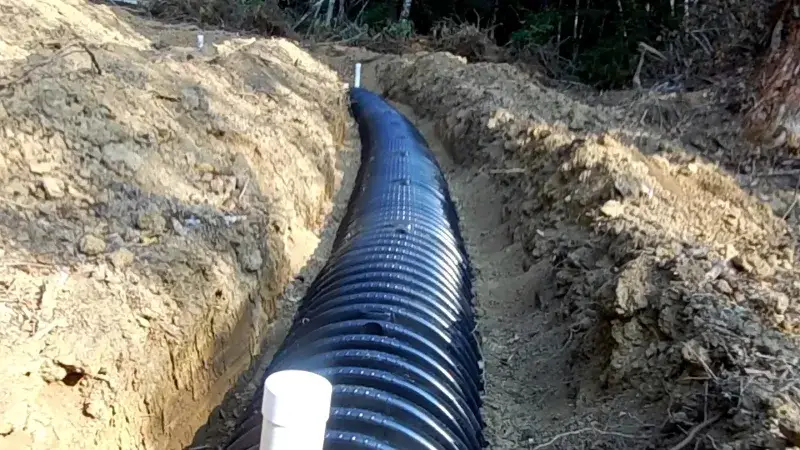
Septic Tank Replacement in Tyler, Texas
A failing septic tank can turn a normal day at home into a messy, urgent problem. Septic tank replacement gives you a properly sized, dependable system that protects your yard, plumbing, and daily routine for the long haul.
About This Service
Replacing a septic tank is more than setting a new tank in the ground. It is the chance to correct a worn-out, damaged, or undersized setup with a system that fits the property, soil conditions, and household use. In Tyler, we help you move from recurring sewage concerns to a clean, dependable wastewater solution designed for everyday living. You end up with a properly planned installation, restored drainage, and confidence when you run the water.
A tank may be nearing the end of its useful life if you notice persistent wet spots, sewage odors, slow drains throughout the house, backups, or unusually lush grass near the tank area. Cracks, corrosion, shifted lids, and repeated pumping needs can also point to a deeper issue. Properties around the Azalea District, Hollytree, and along Old Jacksonville Highway can have very different layouts and soil considerations, so a site-specific assessment matters before deciding whether replacement is the right answer.
Our process starts with a conversation about what you have been seeing, followed by a close look at the existing system and accessible site conditions. We explain the findings in plain language, discuss practical replacement options, and map out the work before excavation begins. Rose City Septic Co. coordinates the job carefully, removes the old tank when needed, sets the replacement at the correct elevation, and connects the system components with attention to a clean, workable finish.
Replacement work is planned to limit disruption to your driveway, landscaping, and daily routine as much as the site allows. The actual schedule depends on access, weather, tank size, excavation conditions, and whether related components need attention. A straightforward replacement can often move efficiently once the plan is set, while a challenging site deserves the extra time required for sound work. In Tyler, clear communication helps you know what is happening before, during, and after the installation.
A well-executed replacement gives your family a stronger foundation for reliable wastewater handling. The tank is selected and positioned to support the system's operation, with connections checked before the site is backfilled and restored. We bring local know-how built since 2005, straightforward recommendations, and responsive service to each project. Rather than pushing a one-size-fits-all answer, we focus on the condition of your property and the solution that makes sense for it.
If your current tank is failing or you are tired of dealing with repeat problems, it is time for a focused evaluation. From homes near Lake Tyler to properties off Broadway Avenue, we are ready to help you understand the next step and complete the work with care. Contact Rose City Septic Co. today to discuss your septic tank replacement and get a practical plan for moving forward.
Replacing a Tank in Smith County: Permits and Sequence
A tank replacement is not a like-for-like swap in the eyes of the state. Under 30 TAC Chapter 285, altering an existing on-site sewage facility requires authorisation the same way a new installation does, and in Smith County that means planning materials through the county's OSSF programme, a permit before work starts, and a final inspection before the system goes back into service.
That surprises people, and it is worth understanding why the rule exists. Many of the tanks being replaced around Tyler were installed under earlier standards, sometimes decades ago, occasionally with no record at all. Replacing the tank is an opportunity to bring the whole system to current standard, and the county's review is what confirms the rest of the system still works with the new tank.
It also means the evaluation matters. A registered sanitarian or professional engineer looks at the existing disposal area as well as the tank, because a failing tank and a failing absorption field produce identical symptoms at the house and cost very different amounts to fix. Replacing a tank that was never the problem is the most common wasted spend in this trade.
Where the old system genuinely is at end of life, the replacement gets designed to the current soil evaluation rather than to whatever was done in 1988, and the finished system carries a county file — which is worth real money when the property sells.
What East Texas Ground Does to an Old Tank
Tanks fail here for reasons that are specific to this soil. The Bowie and Kirvin profiles that cover Smith County are a sandy loam surface over a clay-rich subsoil, and that clay shrinks and swells with the season. Ground that is bone dry in August and saturated in February moves, and a concrete tank sitting in it moves with it. Over years that produces cracked lids, separated inlet and outlet connections, and infiltration.
Infiltration is the quiet killer. When groundwater enters a compromised tank — and a perched water table forms above the clay layer here every winter and early spring — the tank passes far more volume to the absorption field than the field was designed for. The field then fails, and it looks like a drain field problem when the cause was a tank seal.
Older steel tanks are a separate category. They corrode from the inside out, and a rusted lid is a genuine safety hazard on a property where anyone walks. If your property has a steel tank of unknown age, that is worth an inspection now rather than after something gives way.
When we replace, the new tank is set on properly prepared bedding and backfilled with material that behaves, not dumped into a wet hole. East Texas clay does not install well saturated, and a tank set in mud is a tank that settles and separates again.
What Septic Tank Replacement Costs and What Drives the Number
Septic tank replacement cost is the first question on every one of these calls, and the honest answer is that it splits on one thing: whether the tank is the only problem. A sound disposal area with a failed tank is a far smaller job than a full septic system replacement, and the two look identical from inside the house.
That is why the evaluation comes first. A registered sanitarian or professional engineer looks at the existing absorption area as well as the tank, because replacing a tank that was never the problem is the most common wasted spend in this trade. The cost of septic tank replacement on a property where the field is still good is a fraction of the number where it is not.
Beyond that, septic system replacement cost is driven by the same things that drive a new installation: what the soil boring will accept, how much usable area remains after the property line, well and surface water setbacks, access for a machine, and whether the design has to be an aerobic unit with surface spray rather than a conventional gravity field. On most Smith County clay it does.
Replacing a tank is not a like-for-like swap in the eyes of the state either. Altering an existing on-site sewage facility requires planning materials, a permit before work starts and a final inspection before the system goes back into service — which is also how the finished system ends up documented on the county record, and that is worth real money at resale.
How the Job Actually Runs, Step by Step
No surprises is mostly a matter of telling you the order things happen in before they happen. This is how a job runs from your first call to the day it is signed off.
- You call, we talk about the propertyAcreage, bedroom count, whether there is a well, and what is already in the ground. Five minutes on the phone rules out half the wrong answers.
- Site evaluation and soil boringA registered sanitarian or professional engineer digs test holes and logs the profile. This is the step that decides your system type, and nothing before it is a real number.
- Design and planning materialsThe system is sized to the boring and the usable area left after every setback, then drawn up as planning materials for the county.
- County review and permit to constructSubmitted to whichever county your parcel sits in. Nobody breaks ground until the permit is issued.
- Installation, scheduled around the weatherEast Texas clay does not install well saturated. We plan the dig around the forecast rather than setting a tank in a muddy hole.
- County final inspectionThe authorized agent inspects before the system is covered and placed in service. That inspection is what puts a documented system on the county record.
- HandoverYou get the paperwork, the as-built location of the lids, and — on an aerobic system — the maintenance contract set up before we leave.
Why Rose City Septic Co.
- Working East Texas since 2005Two decades on Smith County ground. The soil behaviour described on this page is not research, it is what we dig through.
- We run the county process weeklySite evaluation, planning materials, permit to construct, final inspection. An installer who files these constantly moves them faster than one who does not.
- Diagnosis before the quote, every timeWe do not price a system or a repair over the phone. The boring log or the open tank decides the number, and we would rather lose the job than guess at it.
- Licensed for aerobic maintenance reportingTexas requires aerobic units to be under contract with a licensed maintenance provider filing reports at least every four months. We can hold that contract rather than leaving you to find someone who can.
- County-inspected, on the recordWork that alters a system gets permitted and inspected, so what you own is documented. That matters at resale far more than it does on the day.
- Local for realTyler, Whitehouse, Bullard, Flint, Lindale, Chandler, Jacksonville and Kilgore are the roads we work daily — not a service radius drawn on a map from another city.
What Smith County Requires When You Replace a Tank
Swapping a tank is not maintenance in the eyes of the regulator. Replacing a septic tank in Smith County is permitted work under 30 TAC Chapter 285, reviewed and inspected by Smith County Environmental Health, and the old tank has to be dealt with properly rather than left buried and forgotten.
How much paperwork the job carries depends on what else changes. Setting a new tank of the same capacity in the same footprint, with a drain field that still performs, is the light version. Increasing capacity, moving the tank, or touching the disposal field pulls the job back toward a full planning review with a fresh site evaluation, because the county is then permitting a modified system rather than a like-for-like replacement.
Decommissioning matters too. An abandoned tank has to be pumped out and then either removed or collapsed and filled so it cannot hold water or become a void. Leaving a sealed empty tank in the ground is both a collapse hazard and a compliance problem when the property sells.
The other thing an inspection catches at this stage is whether the tank is actually the failure. If the drain field is the part that has given up, replacing the tank alone buys you nothing, and we would rather tell you that before you pay for the wrong repair.
Weather, Ground Movement and Why Tanks Fail Here
Tanks in East Texas rarely die of old age alone. They die of ground movement. The clay subsoils under Smith County shrink through a dry summer and swell again with autumn rain, and that annual cycle works on the tank, on the inlet and outlet connections and on the lines running to and from it. Cracked concrete, separated joints and lids that no longer seat are the usual result.
The wet season adds buoyancy. From late autumn through May a perched water table can form on the clay layer, and a tank that is empty or low at the wrong moment can lift, tilt or crack under uplift pressure. That is one of the reasons an old tank left in the ground has to be filled rather than sealed and abandoned, and why we are careful about how long a new tank sits empty before it is put into service.
Timing matters for the replacement itself. Digging a tank hole in saturated clay is slower, messier and harder on your yard, and heavy equipment on wet ground compacts the soil around the excavation in ways that do not fully recover. Late spring through early autumn is the kinder window.
If the tank is already failing in January we are not going to tell you to wait until June. We will just tell you honestly what the yard is going to look like afterwards.
Your Questions, Answered
Frequently Asked Questions
These answers address common septic questions from Tyler-area customers. Every property is different, so a direct conversation is the best way to apply this information to your system.
How do I know if my septic tank needs replacement in Tyler?
Repeated sewage backups, tank-area odors, wet ground, structural damage, or continual problems after pumping can indicate that replacement should be considered. A failing drain field can create similar symptoms, so the tank and connected components need to be evaluated together. Soil, access, and the age of the system all affect the recommendation. An on-site assessment gives you a clearer answer than guessing from one symptom.
How much does septic tank replacement cost in Tyler?
Replacement cost depends on tank capacity, material, excavation access, site conditions, removal of the old tank, and any related repairs discovered during planning. A level, open yard usually requires different work than a tight lot with landscaping or difficult access. The best way to budget is to start with an inspection and a detailed scope of work. That lets you understand what is included before the project begins.
What happens during a septic tank replacement?
The work begins with evaluating the existing system and planning access for excavation and equipment. The old tank is exposed and addressed as required, then the replacement tank is set, connected, and checked before backfilling. Crews work carefully around the designated area, though some disturbance is unavoidable with underground work. You will know the planned sequence and any site-specific considerations before work gets underway.
How long should a new septic tank last?
A quality tank can provide long service when it is correctly installed and supported by sensible system care. Lifespan varies with tank material, soil movement, pumping habits, household water use, and whether damaging items enter the system. Keep vehicles and heavy equipment away from the tank area, and schedule regular pumping based on your household's needs. Addressing small concerns early helps protect the larger investment.
What is the cost of septic tank replacement in Tyler, TX?
It depends almost entirely on whether the drain field is still good. A failing tank over a sound absorption area is a much smaller job than a full septic system replacement. Beyond that, septic tank replacement cost tracks what the soil boring will accept, how much usable area survives the setbacks, and whether the design has to be aerobic. We quote after the evaluation, not before.
Is septic system replacement cost different from replacing just the tank?
Yes, substantially. Replacing the tank alone addresses one component; a full system replacement includes a new disposal area designed to the current soil evaluation. Because a failing tank and a failing field produce identical symptoms at the house, the evaluation is what determines which number applies to your property.
Do I need a permit to replace a septic tank in Smith County?
Yes. Altering an existing on-site sewage facility requires authorisation under 30 TAC Chapter 285, with the county acting as TCEQ authorized agent. That means planning materials, a permit to construct, and a final inspection before the system may be placed back in service.
Why do septic tanks fail in East Texas specifically?
The clay-rich subsoils here shrink and swell with the season, and a concrete tank sitting in ground that moves eventually develops cracked lids and separated inlet and outlet connections. Groundwater then infiltrates through winter and early spring, and the tank passes far more volume to the field than it was designed for. That is why a field failure often traces back to a tank seal.
Get Clear Septic Answers Today
Talk with a local team that has served Tyler since 2005. Tell us about your property, and we will help you understand the right next step with a free estimate.
(903) 857-7325Or fill out the form — we'll be in touch shortly.