
Septic system installation cost in East Texas (2026)
Why the soil decides more of the budget than the contractor does, and how to read a quote you already have.
TL;DR
- National cost guides put a full septic install somewhere around $8,000 on average, with most jobs landing between roughly $3,600 and $12,500.
- That average is close to useless here, because it blends two very different jobs. Conventional systems run in one band and aerobic systems run in a much higher one.
- In East Texas the soil usually decides which band you are in, and it decides before anyone writes you a quote.
- The national cost tables also size tanks by a rule Texas does not use, so a Texas buyer following one can end up pricing a tank that would not pass.
- Aerobic systems cost more to install and carry a legal maintenance obligation afterwards, so the comparison is not just the install number.
The question I get most often is not what a system costs. It is whether the number somebody already handed them is a fair one.
That is a better question, and it is answerable. What it takes is knowing which pieces are in the price, which piece is doing most of the work, and what a quote written before anybody tested the dirt is actually worth.
Rose City does not publish pricing, and nothing below is our number. Every figure here is somebody else's published data, and it is national. What is local is the part that decides where in that range a specific property lands.
The honest answer, and why the average does not help you
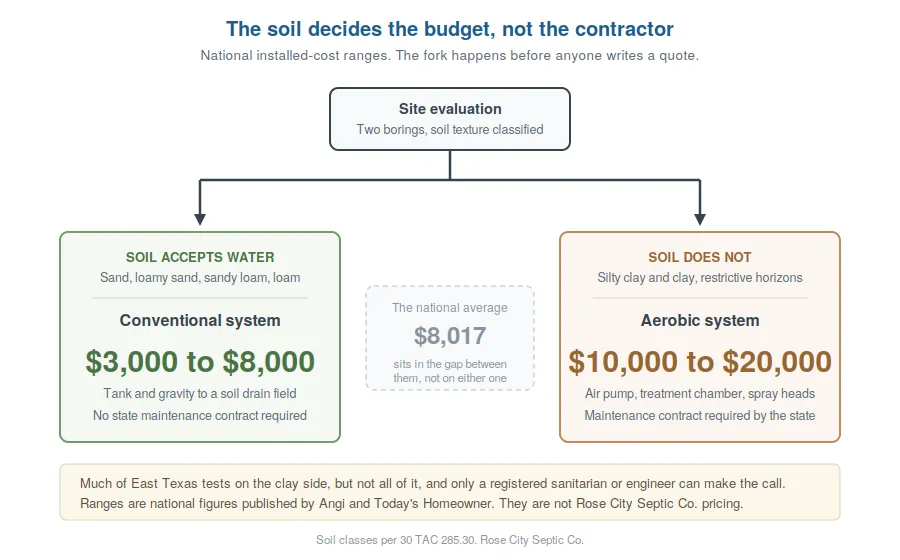
Two national cost guides land within a few dollars of each other. Angi puts the national average for a septic system at $8,017 with a typical range of $3,593 to $12,463. Today's Homeowner puts the same average at $8,011 with a range of $3,610 to $12,412.
When two independent sources agree that closely, the band is real. The problem is what the band is made of, and I have watched that catch people out more than once.
Both sources break the number out by system type, and that is where the average falls apart. A conventional system runs $3,000 to $8,000. An aerobic system runs $10,000 to $20,000. Those are not two ends of one range. They are two different jobs, and the average sits in a gap that very few real installs actually occupy.
So the useful question is not what a septic system costs. It is which of those two you are going to be allowed to build. That is the question I would be asking first, and it is the one a national average cannot answer for a specific lot.
The one variable that decides most of the price
Here is the part that catches people out. That decision is not yours, and it is not the contractor's either.
Texas sorts soil by texture into classes, and the heavy end of the scale is silty clay and clay, with clay subsoils counted as restrictive horizons because water does not move down through them at a workable rate. When the ground under a lot tests that way, the consequence is straightforward. As the Angelina and Neches River Authority puts it, some soil types such as clay are inadequate for proper absorption and treatment, and therefore a conventional system cannot be installed.
A lot of East Texas ground is exactly that. Not all of it, and this is where people get burned in both directions. Plenty of lots in this county test fine for conventional, and the only way to know which kind you have is to test the specific lot.
Smith County is direct about who makes the call: only a registered sanitarian or professional engineer can determine what type of system needs to be installed. In most of East Texas, the perc test result and TCEQ rules determine the system type. Budget comes after the soil data.
Which means a quote written before that result exists is not a quote. It is a guess with a number attached, and it is a guess about the single largest variable in the job. I have heard homeowners given a system type over the phone. Some contractors quote a system type before reviewing the perc results, and the correction, when it comes, is not a small one.
What actually goes into the price
Published national figures for the individual line items, so you can see what a quote is made of:
| Line item | National range | What moves it |
|---|---|---|
| Soil and percolation testing | $700 to $2,000 | Lot size, number of borings required, access |
| Land survey | $330 to $900 | Whether a current survey already exists |
| Permits | $450 to $2,300 | County, system type, and scope |
| The tank itself | $500 to $2,500 | Capacity and material |
| Drain field installation | $5,000 to $12,000 | Field area required, which comes from soil and design flow |
| Excavation | $1,500 to $6,300 | Depth, soil, access, and what has to be worked around |
Source for every row above is the two national guides already cited. Labor is not a separate line because it runs through most of them, and Angi puts it at 50 to 70 percent of the total system cost.
Notice which row is the largest. It is not the tank. People plan a septic budget around the tank because the tank is the part they can picture, and I understand why, it is the part you can stand over and point at. It is also often the smallest hard-goods line in the job. The field is where the money goes, and the field is sized by the soil. Septic system installation is a site job long before it is a tank job.
Why national tank-size tables mislead a Texas buyer
Both cost guides include a table pricing tanks by size, and both map 1,000 gallons to a three or four bedroom house.
That mapping is not the Texas rule, and the full set of Texas minimums is in how big of a septic tank does a house need. Under Texas rules a 4-bedroom house generates a design flow that requires a minimum of 1,250 gallons, and a 1,000-gallon tank covers three bedrooms. A buyer who prices a system off a national table can end up budgeting for a tank that would not pass here.
It is a small thing on a spreadsheet and a real thing in the ground. I pull lids on plenty of tanks that are technically undersized for the house sitting over them, usually because somebody worked off a general rule instead of the Texas one. Worth checking your own house against the actual requirement before you compare any two numbers.
What East Texas adds that a national average cannot
Four things move a local number in ways a national figure will not show you.
Soil, which we have covered, and which is the big one. Everything else on this list is smaller than the conventional-versus-aerobic fork.
Water setbacks. Property near Lake Tyler, Lake Palestine or other surface water carries setback requirements that can shift where the system has to go. Moving a system across a lot changes excavation, pipe runs and sometimes the design.
Access. Long private drives and mature tree cover affect equipment access and route planning. A field that is easy to build 40 feet from a driveway is a different job 300 feet back through trees.
Permitting time. Permit approval can take 2 to 4 weeks depending on county workload and completeness of the application, and installation runs several working days once the permit and site prep are complete. Weather and soil conditions can extend that. County workload is not something any contractor controls, so treat a promised date from anyone as an estimate rather than a commitment.
One more local wrinkle worth knowing. Smith County states that qualifying tracts of 10 acres or more meeting specific criteria need no planning materials, permit or inspection. The criteria matter, so confirm rather than assume, but it is a genuine difference between a large rural tract and a subdivision lot.
The costs that come after the install
An install number is not the whole comparison, and the brand of honesty that matters here cuts against the simpler story.
Aerobic systems cost more up front, and they also carry an obligation afterwards. Texas requires the system to be covered by a maintenance contract with a licensed maintenance provider, and that provider has to inspect the components and file a report with the county and the owner at least once every four months. That is a recurring cost for the life of the system, and it is not optional.
Conventional systems have far less to go wrong and no contract requirement, but they still need pumping, and that is its own budget line covered in how much does it cost to empty a septic tank. I run the maintenance visits on aerobic systems for our contract customers, so I see both sides of that arithmetic every week.
So the comparison is not $3,000 to $8,000 against $10,000 to $20,000. It is those two numbers plus what each system asks for every year after. Anyone who tells you conventional is simply the cheaper option is only counting the first invoice.
How to read a quote you have already been given
What I would want to know, looking at a number on a page:
- Does the quote name a system type, and if it does, was there a soil evaluation before it was written? If not, the largest variable in the job is still unresolved.
- Is the drain field scoped, with an area, or is it a line item with a number next to it? The field is the biggest cost in most installs and the easiest place for a quote to be vague.
- Does the tank size match what the house actually requires under the rules, counting bedrooms and square footage?
- If it is an aerobic system, is the required maintenance contract addressed anywhere, or does it appear after the install as a surprise?
- Does the timeline treat permit approval as fixed? Nobody can promise that.
A quote that answers all five is a real quote. A quote that answers none of them is a number, and the number will move.
That is why a useful estimate starts with questions, not a price list. It is also why a low quote and a high quote on the same property are sometimes both honest and sometimes describing two different jobs, and reading the scope is the only way to tell which.
Getting a number that means something
Every figure on this page is national, published by somebody else, and useful mainly as a frame. None of it is what Rose City charges, because what a specific property needs is not knowable from an article.
What is worth doing before you talk to anyone is the same thing in every case: find out what your soil is. That one result moves the budget more than every other decision in the project put together, and it is knowable early rather than late.
If you are planning a build or replacing a system that has reached the end, we will evaluate the site and give you an actual scope with an actual number. Free on-site estimates, and same-day response is typical. Call or text (903) 857-7325, or get in touch here.
Common Questions Answered
Frequently Asked Questions
How much does a septic system cost to install in East Texas?
National guides put the average around $8,000 with most jobs falling between roughly $3,600 and
Why is an aerobic system so much more expensive?
It is a more complex piece of equipment, and [how does a septic system work](https://www.septicinstallationtylertx.xyz/blog/how-does-a-septic-system-work) explains what those extra parts are doing. An aerobic unit adds a treatment chamber, an air pump, a disinfection step and usually spray heads with their own distribution, where a conventional system is a tank and gravity. Texas also requires ongoing maintenance with reporting to the county, so the difference continues after installation rather than ending at it.
Can I choose a conventional system to save money?
Not if the soil evaluation does not support one. In most of East Texas the perc test result and TCEQ rules determine the system type, and only a registered sanitarian or professional engineer can make that determination. Budget comes after the soil data, which is the opposite order from how most people approach it.
What is the most expensive part of a septic installation?
The drain field, in most jobs. National figures put field installation at $5,000 to
Do I need a permit to install a septic system in Smith County?
Generally yes for properties under 10 acres. Smith County states that qualifying tracts of 10 acres or more meeting specific criteria need no planning materials, permit or inspection, so both the acreage and the criteria matter. Confirm your property's status with the county before assuming either way.
How long does a septic installation take?
Permit approval can take 2 to 4 weeks depending on county workload and how complete the application is, and the installation itself runs several working days once the permit and site prep are done. Weather and soil conditions can extend that. Treat any promised date as an estimate, because county workload is outside any contractor's control.
Get Clear Septic Answers Today
Talk with a local team that has served Tyler since 2005. Tell us about your property, and we will help you understand the right next step with a free estimate.
(903) 857-7325Or fill out the form — we'll be in touch shortly.