
Signs your septic tank is full: 9 warning signs to watch for
Eight signs you notice and one you measure, plus how to tell a full tank from a failing drain field.
TL;DR
- Eight of the nine signs are things you notice, and by the time you notice them the tank has usually been due for a while.
- The ninth is sludge depth measured at the outlet baffle, and it is the only one that gives you warning instead of confirmation.
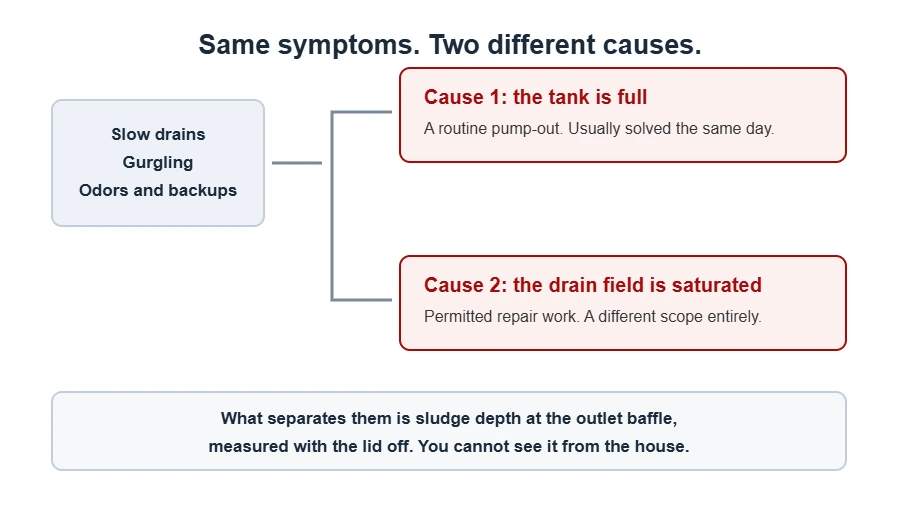
- None of the visible signs tells you whether the tank is full or the drain field is failing, and those are two very different repairs.
- One slow drain is a plumbing problem. Every drain slow at once is a system problem. That distinction saves a wasted call.
- If your system has an outlet filter, a clogged filter produces slow drains on a tank that is not full at all, and cleaning it takes a hose and a few minutes.
Every sign on this page tells you something is wrong. Not one of them tells you what.
That is the part the symptom lists leave out. Slow drains from a full tank and slow drains from a saturated drain field feel identical standing in your bathroom. One of those is a routine service. The other is field work with a permit attached and a very different bill.
So here are the nine signs, what each one actually points at, and how to narrow it down before you call anybody, including us.
The nine signs, in the order they usually show up
- Drains slowing down across the whole house
- Gurgling from drains and toilets
- Toilets needing a second flush
- Sewage odors outside, near the tank or the drain field
- Soggy ground or standing water over the tank or field
- A bright green, spongy strip of grass in dry weather
- Sewage backing up into the house
- The aerobic alarm sounding
- Sludge measured within inches of the outlet baffle
Signs one through eight are things you notice. Sign nine is the only one you go and measure, and it is the only one that shows up early.
1. Drains slowing down across the whole house
The EPA lists bathtubs, showers and sinks draining very slowly as a system warning sign. The key word is the plural.
If your effluent level has risen far enough that the tank is not accepting flow at the normal rate, everything downstream of it slows together. That points at the tank or past it, not at the fixture.
Urgency: moderate. This is usually the first thing people notice and it means you are already past due, not approaching due.
2. Gurgling from drains and toilets
Also on the EPA's list. Gurgling is air being displaced somewhere it should be moving freely.
What I listen for is whether it happens at one fixture or several, and whether it happens when something else is draining. A toilet that gurgles when the washing machine empties is telling you the two are competing for a line that is not clearing properly.
Urgency: moderate, and it usually shows up alongside sign one.
3. Toilets needing a second flush
Not on the federal list by itself, but it is the same mechanism as slow drains showing up in the fixture people notice most.
Worth ruling out the boring explanation first. A weak flush on one toilet with everything else normal is a toilet problem. A weak flush on every toilet in the house is not.
Urgency: low on its own, moderate when it comes with the first two.
4. Sewage odors outside, near the tank or the drain field
The EPA lists sewage odors around the septic tank or drainfield. Note the location.
Odor inside the house near a specific drain is often a dry trap or a vent issue and has nothing to do with your tank. Odor outside, over the tank or the field, is different. That means gas or effluent is finding its way to the surface.
Urgency: higher. Something is reaching a place it should not be.
5. Soggy ground or standing water over the tank or field
Standing water or damp spots near or over the tank or drainfield, in the EPA's words.
This one usually points downstream rather than at the tank. A field that cannot accept the water it is being given sends it up instead. In Smith County clay that happens sooner, because the soil underneath has very little capacity to take it.
Urgency: high, and this is the one I would not sit on.
6. A bright green, spongy strip of grass in dry weather
The EPA describes bright green, spongy lush grass over the tank or drainfield, even during dry weather.
Grass does not read your septic records, it just responds to water and nitrogen. When one strip of the yard stays green in August while the rest goes brown, that strip is being fed. Walk the shape of it. If it follows a line or a rectangle, that is your field telling you where the effluent is going.
Urgency: high. This is often the earliest visible sign of a field problem, and it usually shows up before anything happens indoors.
7. Sewage backing up into the house
The EPA lists water and sewage from toilets, drains and sinks backing up into the home's plumbing.
This is the last sign, not the first. By the time it happens, whatever caused it has been building for a long time.
Urgency: immediate. Stop putting water into the system and get somebody out.
8. The aerobic alarm sounding
Only applies if you have an aerobic system, and plenty of owners are not certain which they have. From the access lid the two can look close to identical.
An alarm is a different kind of signal from the other eight. It is a sensor, not a symptom, and sensors report specific conditions rather than general trouble. More on what to do about it below.
9. Sludge measured within inches of the outlet baffle
This is not something you notice. It is something somebody measures, and it is the only sign on this list that arrives before the trouble does. It gets its own section further down.
Why the whole-house pattern matters more than the symptom
Before anything else, work out whether it is one fixture or all of them.
One slow drain, one gurgle, one weak toilet, everything else fine: that is almost always a plumbing problem inside the house, and a septic truck is the wrong call. I have driven out to plenty of houses where the tank was in good shape and the problem was a clog in one line.
Every drain in the house slowing at the same time, or two fixtures interacting with each other: that is a system problem, and it is worth a septic call.
Your site FAQ puts it the same way, and it is worth repeating: any one sign can have more than one cause.
The problem with all eight of the visible signs
Here is the honest limitation of every list like this one, including mine.
Slow drains, gurgling, odors and backups all happen when a full tank stops accepting flow properly. They also all happen when the tank is fine and the drain field cannot take the effluent the tank is sending it. From inside the house those two situations are indistinguishable.
One of them is a pump-out. The other is drain field repair, which in Texas is permitted work rather than a same-day fix, because almost all on-site sewage facilities require a permit before repair or alteration.
There is one more thing worth understanding, and it is the reason ignoring sign one is expensive. The EPA describes the mechanism plainly: solids in the tank migrate into the drain field and clog the system. A full tank left alone does not stay a tank problem. It becomes a field problem.
That is the whole argument for acting on the early signs rather than the late ones. The jobs I go out on that turn into real money almost never started as expensive problems.
How to narrow it down before you call anyone
Five checks, none of which require opening anything.
Is it one fixture or all of them. Covered above, and it is the first thing I ask on the phone.
Has anything changed in your water use. Ohio State Extension separates systems that are malfunctioning from use and maintenance from systems that are failing from design, installation or age. Excessive water use beyond design capacity, or a lot of water use concentrated together rather than spaced out, is a common cause. So is an unrepaired leak, and the EPA notes a single running toilet can add as much as 200 gallons a day. A toilet running quietly for a month has put thousands of gallons through a system that never signed up for it.
Has anything been driving or parking over the system. Ohio State lists driving or paving over system components as a cause. Texas A&M makes the same point from the soil side: compacted soil reduces infiltration in the absorption field. A truck parked on the field all winter is a real cause of symptoms in spring.
Has the landscaping changed. Ohio State lists landscaping changes that direct outside water into the system. Rerouted downspouts, a new bed with a border that holds water, a regraded driveway. Water arriving from outside the house still has to go somewhere.
When was the outlet filter last cleaned. If your tank has one, and most installed in the last couple of decades do, this is the least expensive thing on the list. Next section.
The clogged filter nobody checks
An effluent filter sits at the outlet and catches solids before they leave the tank. Penn State describes it as the component that captures solids and particulates before effluent moves on, which is exactly what protects the drain field.
It also clogs. Ohio State puts cleaning at 6 to 12 months depending on use.
Run that against a 3 to 5 year pumping interval. That is somewhere between four and ten cleanings you owe between pump-outs, and almost nobody does any of them.
A clogged filter produces slow drains on a tank that is not full at all. Same symptom, completely different cause, and the fix is a hose and a few minutes. I would check this before I would book anything.
What the ninth sign actually is
Everything above is a symptom. This is a measurement.
Oklahoma State Extension puts the threshold at pumping once the sludge layer reaches at least one third of the liquid capacity of the tank, and names the sludge judge sampler as the tool for reading it. Texas A&M frames it as pumping before sludge or scum reaches the bottom of the outlet device. The outlet baffle is the fitting that holds back floating scum and lets clarified liquid through to the field. Once sludge climbs to it, solids start going where solids were never meant to go.
Two other things worth knowing that let you sanity-check your own tank if you can see into it safely.
The liquid level at the outlet end should sit level with the bottom of the outlet pipe. That is normal, and a tank sitting at that level is not a full tank in the sense people mean.
Scum that looks like soil, sometimes with organisms living in it, is normal. Black scum with a foul odor suggests chemicals have damaged the treatment organisms in the tank.
What I am looking for when I open a tank is how much room is left between the sludge and the outlet. And I will not tell an owner the tank is fine when it is not. I have seen tanks a previous contractor called acceptable and I did not agree, and the repair that follows from ignoring a baffle that needed replacing costs more than the straight answer would have.
If your alarm is going off
Aerobic systems get their own answer here, because an alarm is a specific signal rather than a general symptom.
Most alarm calls I take turn out to be a chlorine tablet issue. Some are a pump. A few are something more serious. The history of the system usually points toward which category before anybody drives anywhere.
Three questions before anything else. How long has the alarm been on. When were chlorine tablets last added. Has there been any unusual water use in the last 24 hours.
Those three answers narrow it down a long way, and I would rather ask them than send a truck to a system that does not need one. Sending a truck to every alarm wastes the homeowner's money and my crew's day.
One thing that is not optional: Texas requires a maintenance contract on every aerobic system, with a licensed provider submitting reports at least once every four months and most contracts running quarterly visits. Letting an aerobic maintenance contract lapse creates a compliance violation. That is state law, not an upsell.
What East Texas clay does to the timeline
The national articles assume a field that can absorb what it is given. Around here that assumption does not hold.
Texas classifies soil Ia through IV by how fast water moves through it, and Texas A&M states outright that a standard drain field cannot be used in clay soil because clay does not transmit water at the rate a conventional field needs. TCEQ says most Texas soils cannot properly absorb pollutants on their own, which is why alternative treatment is so common here.
The practical effect on this list: in Smith, Cherokee and Henderson counties, signs five and six show up sooner and escalate faster than they would in sandier ground. A field with nowhere to send water saturates rather than draining, so wet ground over the field is a more urgent signal here than the same symptom would be somewhere else.
I have worked these counties for 21 years and that is the pattern. The tank behaves the same everywhere. The ground underneath does not.
What it costs to wait
The reason to act on sign one instead of sign seven is the difference between two numbers, neither of them ours.
The EPA puts routine septic maintenance at $250 to $500 every 3 to 5 years nationally, and the cost of a failed conventional system at $5,000 to $15,000, with alternative systems running higher. It also puts drain field service life at 25 to 30 years under normal conditions.
Those are national figures and not our pricing. We do not publish pricing. But the shape of the gap is the same everywhere, and solids reaching a field do not shorten its life gently. I would rather pump a tank three times than watch somebody replace a field once.
What happens when you call
So you can see what you are actually booking.
A pump-out with us includes:
- Locating the tank access if it is not already known, which on most lots takes me about 20 minutes with a probe rod.
- Pumping the accumulated solids and scum out of the tank.
- Visual inspection of the baffles and tank walls while the tank is empty and visible.
- A report on tank condition and a recommended next pump date based on what was actually in there.
What it does not include:
- Drain field evaluation, which is a separate service because it is a different assessment.
- Tank repair, which is quoted separately if damage is found.
- Replacement of damaged baffles, which can be quoted at the time of pumping if needed.
If the symptoms point downstream rather than at the tank, a septic inspection is the better starting point. It documents what is visible and accessible, which is the tank location, baffle condition, sludge and scum levels and the state of the field area. It does not certify a system as problem-free, and I would not trust anybody who told you otherwise. What it does is tell you which of the two problems you have before you pay to fix the wrong one.
Getting an actual answer
If you are seeing one of these signs, the useful call is not "my tank is full." It is a description of what is happening and what you know about the system.
When you contact us, we ask about the property, the system history, access, and the symptoms you are noticing. Those answers shape what happens next, and sometimes they mean we tell you it is a plumbing issue rather than a septic one.
We do not publish pricing, because a useful estimate starts with questions rather than a price list. Cost depends on the specific service, the system's location and condition, access to the work area, and whether repairs are involved. On-site estimates are free and carry no obligation.
If nothing is wrong yet and you are just trying to work out when you are due, our guide to how often to pump a septic tank has the intervals by tank size and household.
Rose City Septic Co. has served Tyler since 2005, and we cover Whitehouse, Bullard, Flint, Lindale, Chandler, Jacksonville and Kilgore. Call or text (903) 857-7325 with what you are seeing and whatever system history you have, or request a free estimate. Response is usually same day.
Common Questions Answered
Frequently Asked Questions
How do you know when a septic tank needs to be pumped?
By sludge depth, not by symptoms. Once the sludge layer reaches about one third of the tank's liquid capacity, or approaches the bottom of the outlet device, it is due. Everything you can notice from inside the house shows up after that point, not before it.
What are the first signs a septic tank needs pumping?
Realistically, slow drains across the whole house and gurgling. Both mean you are already past due rather than approaching it. The genuinely early indicator is a measured sludge reading from the last service, which is why the condition report matters more than the receipt.
Can a full septic tank cause sewage to back up?
Yes, and it is the last sign rather than the first. A backup means the system has been unable to accept flow for some time. Stop putting water into it and get somebody out the same day.
How long can you wait once you see the signs?
It depends which sign. Slow drains and gurgling give you some room. Wet ground over the field, surfacing effluent or a backup do not, because at that point untreated wastewater is reaching places it should not. The risk of waiting is not the tank. It is that solids migrate into the drain field, which turns a routine service into a permitted repair.
Does a full tank always mean pumping will fix it?
No, and this is the most useful thing on this page. If the tank is full because it has not been serviced, pumping fixes it. If the tank is full because the drain field cannot accept effluent, pumping empties it and the same thing happens again within weeks. Which one you have gets decided by looking, not by guessing.
Can you take a shower if your septic tank is full?
You physically can, but every gallon you add goes into a system that is already struggling to move what it has. If you are seeing backups or surfacing water, keeping water use to a minimum until somebody looks at it is the sensible move.
Get Clear Septic Answers Today
Talk with a local team that has served Tyler since 2005. Tell us about your property, and we will help you understand the right next step with a free estimate.
(903) 857-7325Or fill out the form — we'll be in touch shortly.