
How big of a septic tank does a house need?
The Texas minimum for a 3, 4, 5 and 6 bedroom house, and what each common tank size actually supports.
TL;DR
- Texas does not size a septic tank by how many people live in the house. It sizes it by bedrooms and square footage, then converts that to a daily flow figure and picks a tank from a table.
- A 3-bedroom house under 2,500 square feet needs a minimum of 1,000 gallons. A 4-bedroom under 3,500 square feet needs 1,250 gallons.
- A 1,000-gallon tank covers a 3-bedroom house. A 1,500-gallon tank covers anything up to a 6-bedroom house, which is why it is the common upsize.
- Water-saving fixtures lower the design flow enough to drop some houses a full tank size.
- The code number is a floor. It is what you are allowed to install, not necessarily what the household should have.
Two houses on the same road, both 3 bedrooms, both with a 1,000-gallon tank that meets code. I service them on the same rotation. One comes up right where I expect it, and the other comes up heavy every single time.
Nothing is wrong with either tank. The difference is who lives in them. If you want the mechanics first, how does a septic system work covers what the tank is actually doing with that water. Bedrooms are a stand-in for people, and a stand-in is only as good as the assumption underneath it.
So here is how Texas actually arrives at a tank size, what the minimum is for each house size, and where that number stops being enough.
The short answer, by bedroom count
These are the minimum tank sizes under Texas rules for a standard septic system, assuming no water-saving fixtures.
| Bedrooms | Square footage under | Design flow | Minimum tank |
|---|---|---|---|
| 1 or 2 | 1,500 | 225 gallons a day | 750 gallons |
| 3 | 2,500 | 300 gallons a day | 1,000 gallons |
| 4 | 3,500 | 375 gallons a day | 1,250 gallons |
| 5 | 4,500 | 450 gallons a day | 1,250 gallons |
| 6 | 5,500 | 525 gallons a day | 1,313 gallons |
Two things in that table surprise people, and I get asked about both at the lid.
A 4-bedroom and a 5-bedroom house land on the same 1,250-gallon minimum, because both design flows fall inside the same band in the rules. And the jump from 5 to 6 bedrooms only adds about 63 gallons of required capacity. The steps are not even, because the tank table and the flow table are two different documents that meet in the middle.
The square footage column is not decoration either. A 3-bedroom house over 2,500 square feet does not stay on the 3-bedroom row. It moves up.
How the number is actually calculated
It runs in two steps, and knowing both is what lets you check a quote instead of taking it on faith.
Step one is the daily flow. Texas rules assign every house a wastewater usage rate based on bedrooms and living area. The published figures are 225 gallons a day for one or two bedrooms under 1,500 square feet, 300 for three bedrooms under 2,500, 375 for four, 450 for five, and 525 for six. Past 5,500 square feet it adds 75 gallons a day for each additional 1,500 square feet.
Step two is the tank. That flow figure gets looked up in a second table. A flow of 250 gallons a day or less needs 750 gallons of tank. From 251 to 350 it is 1,000 gallons. From 351 to 500 it is 1,250 gallons. Above 500 a day the table stops giving fixed numbers and switches to a formula, 2.5 times the daily flow.
That is the whole calculation. Bedrooms and square feet in, gallons out. I walk homeowners through those two steps more often than anything else on this subject, because once you have seen it done you can check any quote you are handed in about a minute.
The tank also has to meet build requirements beyond volume. Texas requires the liquid depth to be at least 30 inches, the tank to be divided into two or three compartments, and the inlet flowline to sit at least 3 inches above the outlet. A tank is not just a box that holds the right number of gallons.
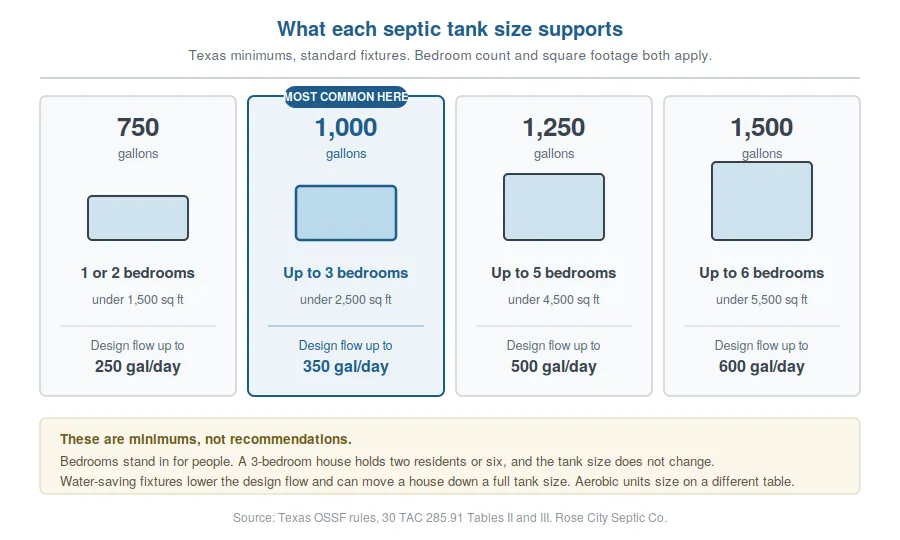
What each common tank size supports
This is the same math run backwards, which is usually the question people are actually asking when they are standing in a yard looking at a lid.
| Tank size | Supports, standard fixtures | Supports, water-saving fixtures |
|---|---|---|
| 750 gallons | 1 or 2 bedrooms | Up to 3 bedrooms |
| 1,000 gallons | Up to 3 bedrooms | Up to 4 bedrooms |
| 1,250 gallons | Up to 5 bedrooms | Up to 6 bedrooms |
| 1,500 gallons | Up to 6 bedrooms | Up to 6 bedrooms |
A 1,000-gallon tank is a 3-bedroom tank. It is the most common thing I pull a lid on around here by a wide margin, which is why so much of what gets asked about septic pumping is really about 1,000-gallon tanks. If you have one, the schedule side of it is covered in how often should a 1,000-gallon septic tank be pumped.
The 1,500-gallon tank is the interesting one. It clears the requirement for every house size in the table, right up to 6 bedrooms. That is why it shows up so often on new installs where the owner wanted margin without going to a custom size. It is not required for a 4-bedroom house. It is just the next size that is easy to buy.
Water-saving fixtures can move you down a size
Texas publishes a second column for houses with water-saving devices, and the reduction is real. A 3-bedroom house drops from 300 gallons a day to 240. A 4-bedroom drops from 375 to 300.
Run those through the tank table and the effect is a full size. A 3-bedroom with water-saving fixtures qualifies for a 750-gallon minimum instead of 1,000. A 4-bedroom drops from 1,250 to 1,000.
I would not use that to buy a smaller tank. Fixtures get replaced by the next owner, and the tank stays in the ground for decades. But it is worth knowing, because if your house is on the edge of a size band, it explains why two similar houses down the road got different tanks.
Aerobic systems are sized on a different table
If the soil on the lot requires an aerobic system, and a lot of East Texas soil does, the numbers change. Aerobic units are rated on treatment capacity per day rather than tank volume, and the required capacity runs higher than the conventional flow figures: 360 gallons a day for a 3-bedroom under 2,501 square feet, 480 for a 4-bedroom, 600 for a 5-bedroom and 720 for a 6-bedroom, with 120 added for each additional bedroom.
That fork also moves the budget more than any other decision in the project, which is covered in septic system installation cost in East Texas. So a 3-bedroom house that would need a 1,000-gallon conventional tank needs a unit rated for 360 gallons a day if it goes aerobic. Different table, different spec, same house. I maintain both types every week, and the sizing question is the first place the two stop resembling each other. If the soil evaluation points that direction, aerobic system installation is a different sizing conversation from the start, not a substitution at the end.
Why the code minimum is a floor, not a recommendation
Every number above is a minimum. It is the smallest tank the state will let somebody put in for that house. It is not a statement that the tank is the right size for the family living there.
Bedrooms are a proxy for occupancy, and the proxy holds up until it does not. Three bedrooms can hold two people or six. The EPA puts the average American family at more than 300 gallons of water a day at home with roughly 70 percent of it used indoors, which lands near 210 gallons a day going into the system. The code assumes 300 for that same 3-bedroom house. There is margin built into the rule, and a full house spends it.
What I see at the pump-out is the result of that. Tank size is one of the things that moves a pumping interval, right alongside household size and what goes down the drains. A minimum-size tank in a busy house gives solids less quiet time to settle before the next surge pushes liquid out the other end, and that shows up as sludge that comes back faster than the calendar says it should. I have pumped tanks on a three-year rotation that looked like nobody had touched them in a decade.
None of that means the tank was installed wrong. It means the tank was installed to the number, and the number assumed a household that did not show up.
Adding a bedroom to a house already on septic
This is where sizing becomes a live problem for people who were not planning a septic project.
Finishing an attic, converting an office, or adding a room changes the bedroom count and the square footage, which changes the design flow, which can change the required tank and the required drain field. The system that met code for a 3-bedroom house may not meet it for a 4-bedroom house.
It is worth checking before the framing goes up rather than after. A permitted addition usually gets looked at, and an unpermitted one still creates a real capacity problem even if nobody comes out. I have opened plenty of tanks that were sized correctly for the house that was originally built and are now carrying two more people than anyone planned for. If the existing tank is undersized for what the house is becoming, tank replacement is the conversation, and it is a much easier one before there is a finished room sitting over the line.
The tank is only half the sizing question
The tank gets all the attention. The drain field is the part that is expensive to get wrong, and it is the part I spend the most time explaining.
Field size comes off the same daily flow figure, then gets adjusted for what the soil can absorb. Texas classifies soil by texture, and the evaluation is physical: two borings or two backhoe pits at opposite ends of the proposed field area. Heavy clay takes water slowly, so the same house on two different lots can need very different amounts of field.
Smith County is direct about who makes that determination. Only a registered sanitarian or professional engineer can determine what type of system needs to be installed. In most of East Texas, the perc test result and TCEQ rules determine the system type. Budget comes after the soil data.
That is also the honest limit on every number above. The tables tell you the minimum for a house of a given size. They do not tell you what your specific lot will take, and no one can tell you that from a phone call. Septic system installation starts with the site, and tank sizing comes out of it rather than going into it.
Getting the size right for your lot
The tables above will tell you the minimum for a house like yours. That is useful for checking a quote, or for working out whether the tank you inherited is the right one for the house sitting on top of it.
What they will not tell you is what your ground will accept, and that is the part that sets the real scope. Two identical houses a mile apart can need very different systems because one sits on sandy loam and the other sits on clay.
If you are planning a build, adding on, or trying to find out whether the tank already in your yard fits the house above it, we can evaluate the site and give you the actual numbers. Free on-site estimates, and same-day response is typical. Call or text (903) 857-7325, or get in touch here.
Common Questions Answered
Frequently Asked Questions
How many bedrooms will a 1,000-gallon septic tank support?
Three bedrooms in a house under 2,500 square feet, under Texas rules with standard fixtures. A 3-bedroom house generates a design flow of 300 gallons a day, and the tank table requires 1,000 gallons for any flow between 251 and 350. With water-saving fixtures a 1,000-gallon tank covers a 4-bedroom house, because the lower flow figure drops it into the same band.
How many bedrooms will a 1,500-gallon septic tank support?
Up to six bedrooms. A 6-bedroom house under 5,500 square feet generates 525 gallons a day, and the formula for that range works out to about 1,313 gallons of required capacity, which a 1,500-gallon tank clears. That is why 1,500 gallons is a common choice on new installs even when a smaller tank would satisfy the rule.
What size septic tank do I need for a 4-bedroom house?
A minimum of 1,250 gallons with standard fixtures, based on a design flow of 375 gallons a day. With water-saving fixtures the flow drops to 300 a day and the minimum becomes 1,000 gallons. Square footage matters too, because a 4-bedroom house over 3,500 square feet moves to the next row.
Does the number of people living in the house change the required tank size?
Not for permitting. Texas sizes the system on bedrooms and square footage, not on occupancy, so a couple and a family of six in identical houses get the same required tank. Occupancy does change how the tank behaves in practice, which is why a minimum-size tank in a full house tends to need pumping sooner.
Is a bigger septic tank always better?
A larger tank gives wastewater more settling time and more margin for heavy use, which is genuinely useful. It is not a substitute for a correctly sized drain field, and it does not remove the need to pump. Oversizing also costs more to install and does not help if the soil is the limiting factor on the lot.
Can I add a bedroom to a house on a septic system?
Sometimes, and it depends on whether the existing tank and drain field meet the requirement for the larger house. The added bedroom raises the design flow, which can raise both the minimum tank size and the required field area. Have the system evaluated against the new bedroom count before construction rather than after.
Get Clear Septic Answers Today
Talk with a local team that has served Tyler since 2005. Tell us about your property, and we will help you understand the right next step with a free estimate.
(903) 857-7325Or fill out the form — we'll be in touch shortly.