
How often should a 1,000-gallon septic tank be pumped?
A 1,000-gallon septic tank needs pumping every 2.6 years for a family of four and every 5.9 years for two people. Here is the math, and what changes it.
TL;DR
- A 1,000-gallon tank runs about 3.7 years between pump-outs for three people, 2.6 years for four, and 1.5 years for six.
- This is the Texas minimum tank size for a three-bedroom house, which makes it the most common tank under homes in Tyler and Smith County.
- The tank was sized against the house at permit time, not against the family living in it now, and that mismatch is what puts most people off schedule.
- A 1,000-gallon tank holds only about 300 gallons of usable sludge storage, and a garbage disposal cuts the whole interval by 1 to 2 years.
- The chart gives you a planning date, but the sludge depth measured at the outlet baffle is what actually settles it.
Most houses I pump in Tyler sit on a 1,000-gallon tank. That is the Texas minimum for a three-bedroom, and almost nobody installs above the minimum.
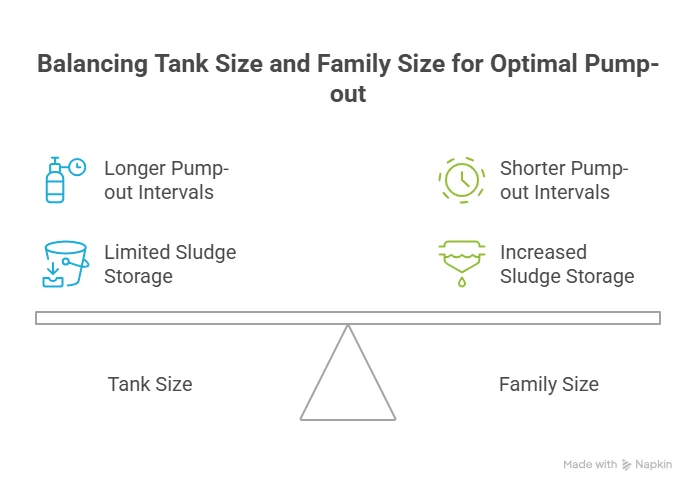
Here is the part that catches people. The county sized that tank against the house. Three bedrooms, 400 gallons a day, 1,000-gallon tank, permit approved. Bedrooms do not use water though. People do. I have pumped 1,000-gallon tanks under three-bedroom houses with two people living in them, and tanks under the same floor plan with six. Same permit. Completely different schedule.
Your tank was sized for the floor plan. Your interval comes from who is living in it.
How often to pump a 1,000-gallon tank, by household size
This is the answer, and everything after it is the reasoning.
| People in the house | Years between pump-outs |
|---|---|
| 1 | 12.4 |
| 2 | 5.9 |
| 3 | 3.7 |
| 4 | 2.6 |
| 5 | 2.0 |
| 6 | 1.5 |
Those figures come from an extension table published by Ohio State University Extension for a year-round residence. Oklahoma State Extension publishes a separate table built independently and lands in the same range, roughly 12 years for one person and three years for four. Texas A&M runs the same calculation for a three-bedroom house on a 1,000-gallon tank and arrives at 2.6 years for four occupants and 5.9 for two.
Three sources, same answer. That is about as settled as this gets on paper.
Why a three-bedroom house in Texas gets a 1,000-gallon tank
Texas sets minimum tank capacity by the size of the house, and the ladder is short:
That 400-gallon figure is the design assumption, not a limit anybody enforces. Nobody meters your house against it.
| Bedrooms | House size | Minimum tank |
|---|---|---|
| 1 to 2 | Under 1,500 sq ft | 750 gallons |
| 3 | Under 2,500 sq ft | 1,000 gallons |
| 4 | Under 3,500 sq ft | 1,250 gallons |
A three-bedroom house is designed against roughly 400 gallons of wastewater a day. That is the number the tank was permitted to. Oklahoma State Extension uses the same 400 gallons as the daily design flow for a family of four.
So the system as designed assumes a family of four, and a family of four is the exact case that puts you on a 2.6 year interval. The tank is not generous. It is adequate, and only barely, for the household it was drawn for.
The 300 gallons that actually decide your schedule
The tank holds 1,000 gallons. You do not get 1,000 gallons of room.
Most of that volume is working liquid that has to stay in the tank so wastewater gets its settling time. What you have for accumulated solids is roughly 300 gallons of sludge storage before things start reaching the outlet.
Now the input side. One adult puts about 90 gallons of solids into the system a year, which bacteria reduce to somewhere near 60. Penn State Extension puts a family of four at filling that 300-gallon storage capacity in roughly a year and a half.
That is not a mistake in the chart. The chart says 2.6 years and the storage math says 1.5. The difference is that scum is building down from the top at the same time sludge is building up from the bottom, and the safe interval accounts for both while leaving working room in the middle.
What I am looking for when I pull the lid is how much of that middle is left.
When a 1,000-gallon tank is undersized for the house it serves
This is the situation nobody plans for, and I run into it constantly.
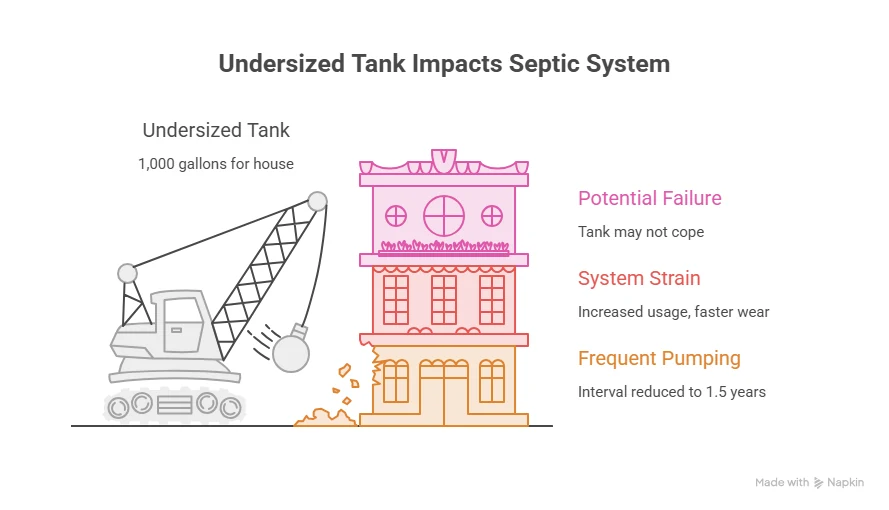
A three-bedroom house holds three people or it holds seven. The tank does not adjust. A family grows. A parent moves in. A house gets bought as a rental and four bedrooms' worth of people end up in a three-bedroom floor plan. Every one of those is a legal, correctly permitted system running on an interval that has quietly gone from 3.7 years to about 1.5.
Nothing about the tank is wrong. The tank is doing exactly what a 1,000-gallon tank does. The schedule the previous owner wrote on the panel is what is wrong.
If you are on a 1,000-gallon tank with five or more people in the house, you are on a two-year interval at best, and closer to 18 months with a disposal. That is worth knowing before you inherit somebody else's assumption.
Upsizing is a real option in some cases, though it is a different scope of work with permitting attached, and it is not the automatic answer. A septic tank replacement makes sense when the tank is failing or genuinely wrong for the property. Pumping on the correct interval is cheaper than replacing a tank that works.
What shortens the interval further
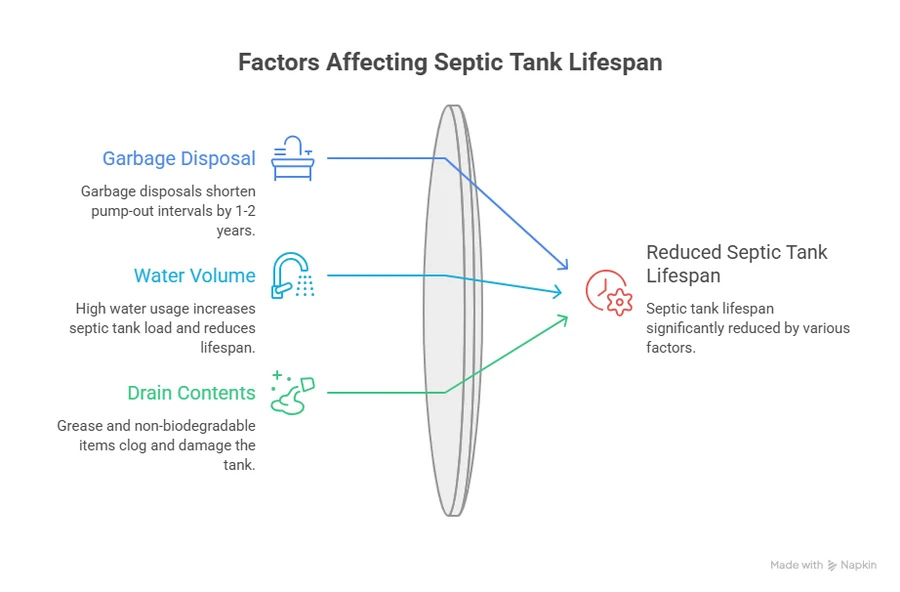
A garbage disposal costs you 1 to 2 years. Texas A&M states that garbage disposals reduce pump-out intervals by 1 to 2 years. On a 1,000-gallon tank that is severe, because you did not have much room to start with. Four people on this tank with a disposal are not at 2.6 years. They are closer to 1.5.
Water volume matters more than people think. The EPA puts average indoor use at up to 70 gallons per person per day and notes that one running toilet can add as much as 200 gallons a day by itself. On a tank designed for 400 gallons a day, a running toilet is half the design flow going through with no settling time behind it.
What goes down the drain. Grease is the one I see most. It floats, it thickens the scum layer, and it eats your working volume from the top while sludge eats it from the bottom. The EPA is direct: only human waste and toilet paper, and that means no wipes, no coffee grounds, no cat litter, no paper towels.
What to do when there are no records
The most common version of this tank I meet is a rural three-bedroom bought from somebody who did not know what they had.
An agent sent me a buyer three days out from closing on a property near Chandler. Seller said the system was fine. No records existed, no map, nobody could say where the tank was. I probed the yard and found it, pulled the lid, and looked at the baffles first. The inlet baffle had partially collapsed. Not catastrophic yet, but it needed to come out.
I wrote it up in plain language. What was there, what the repair was, what a replacement scenario would look like if the repair did not hold. He took the report to the negotiating table and got a credit at closing. The baffle got replaced two weeks after the sale.
That buyer knew more about that septic system than the family who had lived on the property for 20 years. That is what a baseline inspection is supposed to do.
If you bought a house and the last pump date is somebody's recollection instead of a document, you do not have a schedule. You have a guess. Getting one real look at the tank converts it.
The sludge depth still overrides the chart
Every number on this page is an estimate built from averages. The tank is not an average.
The working rule is that a tank needs pumping once the sludge layer reaches 25 to 33 percent of the liquid capacity, measured near the outlet baffle. That fitting is what holds back floating scum and lets clarified liquid pass to the drain field. Once sludge climbs to it, solids start going somewhere they were never meant to go.
I pumped a tank near Chandler where the sludge was within 2 inches of that baffle. Another six months and it would have been carrying solids into the field.
So use the chart to plan and use the pump-out report to correct it. A tank that comes up nearly clean at three years earns a longer interval. One that comes up loaded earns a shorter one. If nobody tells you what the sludge depth was, you learned nothing and you are still guessing.
For how this works across other tank sizes and what East Texas clay soil does to the picture, see our full guide to pumping frequency by tank size [HUB-URL].
Getting a real interval for your tank
If you have a 1,000-gallon tank and you know how many people are using it, the table above gives you a working date today. If you inherited the property and the history is somebody's memory, the table is a starting point and the sludge depth is the answer.
Two numbers and I can tell you when to book. Tank size and how many people are in the house.
Rose City Septic Co. has served Tyler since 2005, and we cover Whitehouse, Bullard, Flint, Lindale, Chandler, Jacksonville and Kilgore. Call or text (903) 857-7325 with your tank size and roughly when it was last pumped, or request a free estimate. On-site estimates are free and response is usually same day.
Sources
- Ohio State University Extension (Ohioline) — septic pumping interval tables
- Oklahoma State University Extension — septic tank pumping frequency tables
- US EPA — Septic Systems (Decentralized / Onsite Systems)
Common Questions Answered
Frequently Asked Questions
How often should a 1,000-gallon septic tank be pumped for a family of four?
About every 2.6 years, and closer to 1.5 years with a garbage disposal. Four people is the design case for a three-bedroom house, so this is the most common answer in Smith County. If somebody told you five years, they were quoting the general 3 to 5 range without looking at your household.
How long can a 1,000-gallon tank go with two people?
Around 5.9 years by the extension tables. That is one of the few residential cases where the upper end of the 3 to 5 year range is genuinely conservative. I would still get eyes on it at three years, because a baffle does not care how few people are in the house.
Can a 1,000-gallon tank go five years without pumping?
For one or two people, yes. For four, no. At four occupants you are roughly two years past due at the five-year mark, and past due on this tank means sludge approaching the outlet baffle.
How many bedrooms will a 1,000-gallon septic tank support?
Three, under Texas minimum sizing for a house under 2,500 square feet. That is a permitting answer, not an occupancy answer. It says nothing about how many people can live there.
Should I upsize from a 1,000-gallon tank?
Only if the tank is failing or the household is permanently larger than the system was drawn for, and only after somebody looks at the site. Replacement is a permitted scope of work. Pumping on the right interval solves most of what people think a bigger tank would fix.
How do I confirm I actually have a 1,000-gallon tank?
Three places. The permit record at the county is the reliable one. The stamp on the tank lid, if you can get to it. Or the report from the last pump-out. I have been on plenty of properties where the owner did not even know whether the system was conventional or aerobic, and from the access lid the two can look similar.
Get Clear Septic Answers Today
Talk with a local team that has served Tyler since 2005. Tell us about your property, and we will help you understand the right next step with a free estimate.
(903) 857-7325Or fill out the form — we'll be in touch shortly.