
How much does it cost to empty a septic tank? Price ranges and what moves them
Septic pumping runs roughly $250 to $700 for most homes nationally, but tank size, access, and a buried lid move that number a lot. What drives the price and how to read a quote.
TL;DR
- Published national figures put a typical residential pump-out somewhere between $255 and $700, with the EPA putting routine septic maintenance at $250 to $500 every 3 to 5 years.
- Tank size sets the baseline, and a three-bedroom house in Texas is most likely on a 1,000-gallon tank, which sits in the middle of every published range.
- Four things move the number more than anything else: how much is actually in the tank, whether the truck can reach it, whether the lid has to be dug up, and how far the truck drives.
- A buried tank lid costs you money at every single service for as long as you own the house, and an access riser is the one fix that ends that permanently.
- The useful way to think about the cost is per year rather than per visit, because a pump-out is a bill spread across two to five years, not an annual expense.
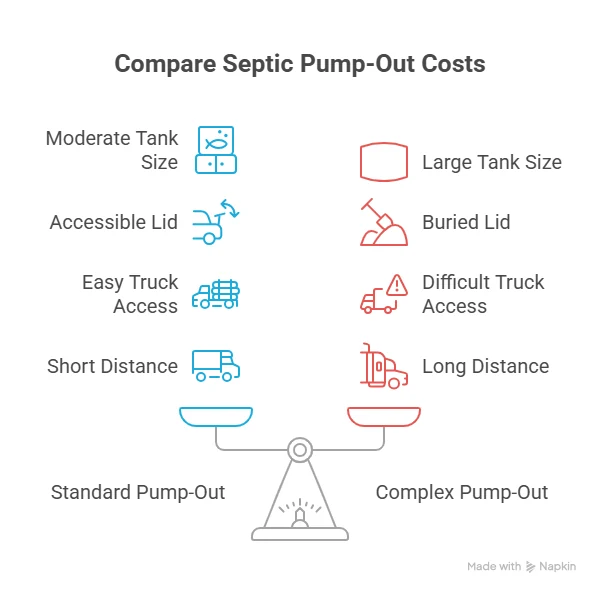
When somebody calls and asks what it costs to empty a septic tank, I do not open with a number. I ask four questions first. How big is the tank. When was it last pumped. Does anybody know where the lid is. What does the driveway look like.
That is not me stalling. Those four answers are most of the price. A 1,000-gallon tank with an accessible riser 30 feet off a paved drive and a 1,500-gallon tank buried somewhere under a back yard at the end of a quarter mile of soft ground are two completely different jobs, and they are going to come back as two completely different numbers.
Here is what the published ranges actually say, and here is what moves you around inside them.
What a septic tank pump-out typically costs
Nobody in government publishes a price for this, so the numbers below come from two home services publishers that survey contractors, plus the EPA's own maintenance figure. None of these are our prices. We do not publish pricing, and any honest number for your property comes from looking at it.
The EPA puts routine septic maintenance at $250 to $500 every 3 to 5 years.
Angi reports a 2026 national average of $428, with most jobs falling between $292 and $564.
Today's Homeowner reports a typical cost closer to $400, with a range of $255 to $600, noting that rural work can run as low as $200 while high-cost metros can pass $800.
So the working answer is roughly $250 to $700 for most residential tanks, and the spread inside that range is not random. It is the job.
Septic pumping cost by tank size
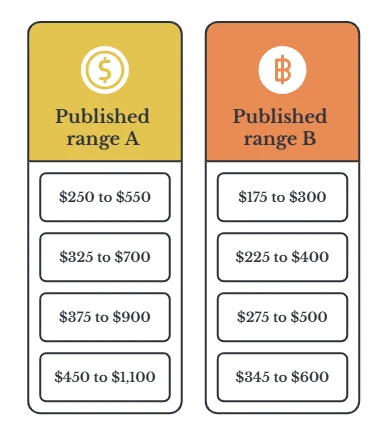
Tank size is the first variable, because a vacuum truck charges for volume and time and both scale with the tank. Here is what the two sources publish side by side.
| Tank size | Published range A | Published range B |
|---|---|---|
| 750 gallons | $250 to $550 | $175 to $300 |
| 1,000 gallons | $325 to $700 | $225 to $400 |
| 1,250 gallons | $375 to $900 | $275 to $500 |
| 1,500 gallons | $450 to $1,100 | $345 to $600 |
Look at the gap between those two columns before you look at anything else. Two publishers surveying real contractors put a 1,000-gallon tank at $325 to $700 and at $225 to $400. That is not one of them being wrong. That is what happens when you average a job that changes by region, by access, and by how long the tank has been sitting.
Which is the whole point. A national average tells you what a septic pump-out costs in America. It does not tell you what your tank costs.
What size tank you probably have
If you do not know, the house tells you. Texas sets minimum capacities by bedroom count, and most systems were installed at or near that minimum: 750 gallons for a one to two bedroom house, 1,000 gallons for three bedrooms, 1,250 gallons for four.
A three-bedroom house in Tyler is almost certainly on a 1,000-gallon tank. That puts you in the middle row of the table above.
If you want it confirmed rather than assumed, the permit record at the county is the reliable source, and a septic inspection will give you the tank size, the condition, and the location in one visit if no records exist.
What actually moves the price
Your service details file says it plainly: cost depends on the specific service, the system's location and condition, access to the work area, and whether repairs or installation planning are involved. Here is what each of those looks like on an actual job.
I can usually get within range of a number over the phone if somebody answers those four questions honestly. It is the honest part that trips people up, because most owners genuinely do not know when the tank was last done.
How much is in the tank, not just how big it is
A 1,000-gallon tank that has been on a 3-year schedule and a 1,000-gallon tank that has not been touched in 14 years are the same tank on paper. They are not the same pump-out. Heavy sludge that has compacted at the bottom takes longer to break up and draw out, and sometimes it takes water back into the tank to move it at all. Longer on site, higher number.
Whether the truck can get to the tank
The hose has a working length. Past that, you are adding hose, and past that, you are moving the truck onto ground it may not belong on. Soft yards after a wet week, long private drives, gates too narrow for a tandem axle, mature tree cover on the approach. Every one of those adds time, and time is what you are actually paying for.
Whether the lid has to be located or dug up
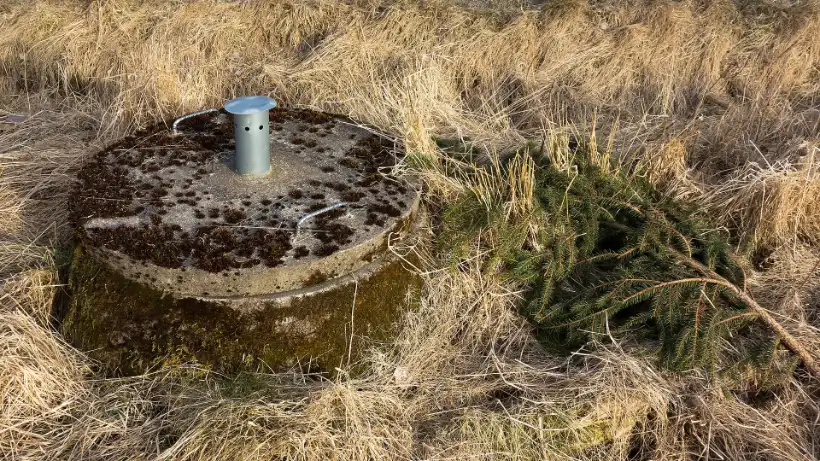
Locating a tank on most lots takes me about 20 minutes with a probe rod. Digging one out is a different job. If the lid is 18 inches down under a flower bed the previous owner planted over it, somebody is moving dirt before anybody pumps anything. More on this below, because this is the one you can fix.
How far the truck has to drive
We cover Whitehouse, Bullard, Flint, Lindale, Chandler, Jacksonville and Kilgore alongside Tyler, and a run out to Kilgore is not the same drive as a run across town. Fuel is a real input to this trade. The EIA tracks Gulf Coast diesel and when that moves, service pricing across the region moves with it eventually. It is also why the published rural figure can be lower than the metro figure in one survey and higher in another. It depends entirely on how far the truck came.
Where the septage goes afterward
This is the leg nobody thinks about. What comes out of your tank cannot be taken anywhere convenient. In Texas, anyone hauling domestic septage has to be registered with TCEQ as a sludge transporter under 30 TAC Chapter 312. Texas A&M puts the same rule in plainer words: only people registered with TCEQ may pump and transport septic tank sludge. The disposal site, the drive to it, and the compliance behind it are all priced into the number you get quoted, whether or not the quote breaks it out.
Scheduled versus emergency
A pump-out you booked two weeks ago and a pump-out you need because sewage is coming up in a shower on a Saturday are not priced the same anywhere in this trade. The lowest-cost version of this service is the one you scheduled.
The buried lid is the one cost driver you can permanently fix
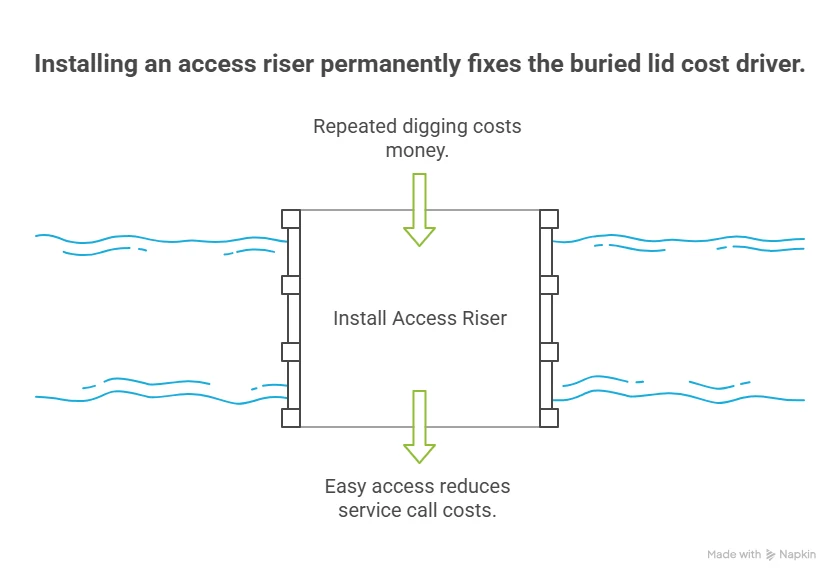
Everything above is mostly outside your control. This one is not.
I have dug out lids that three previous owners paid somebody to dig out. Same hole, four times, four bills.
If your tank lid is buried, every service call for as long as you own that property includes finding it and uncovering it. Not once. Every time. Pumping, inspection, a baffle repair, a real estate inspection before you sell. Same dirt, moved again.
An access riser ends that. It is a collar that brings the tank opening up to grade with a lid you can lift. The EPA describes risers as low-cost improvements that help owners and inspectors easily locate the tank and avoid the need to repeatedly dig up the lawn for routine inspections. PVC risers can be cut to grade so they sit nearly flush.
If you are having your tank pumped anyway and the lid is buried, that is the moment to ask about a riser. The tank is already open and located. Doing it later means paying to find the lid one more time first.
Why the number you found online does not match your quote
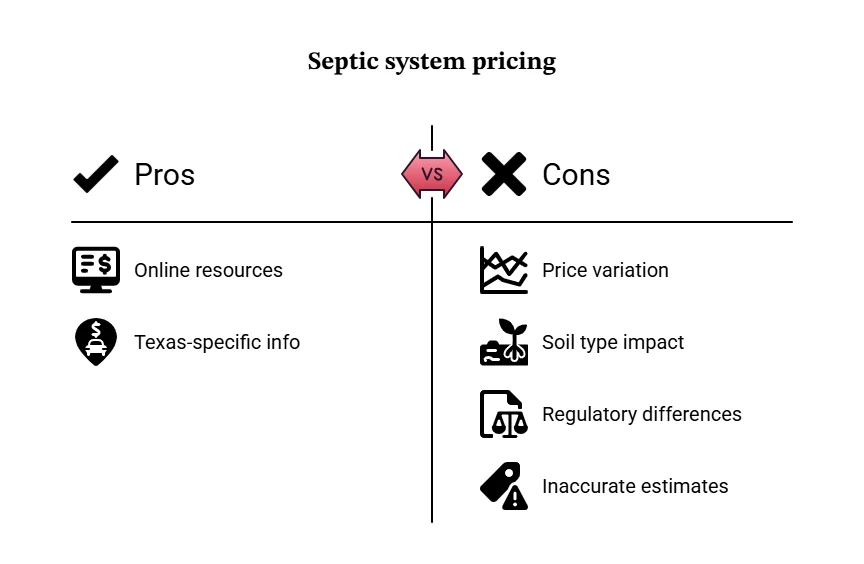
Regional spread on this service is wide. One published survey lists metro examples running from $175 to $275 in one city and $440 to $750 in another. Rural work can come in under $250 or over $800 depending on the drive.
There is also a Texas-specific problem with searching this online. A lot of the Texas septic pricing you will find was written for the Hill Country, where the ground is limestone and excavation means rock. Smith County is clay. Texas A&M states outright that a standard drain field cannot be used in clay soil, which is why so many properties around here are on aerobic systems in the first place. Different ground, different work, different regulatory picture, different number.
If a price range was built around somebody else's dirt, it is not going to describe your quote. Check whether a published figure is anywhere near your service area before you anchor on it.
What it costs per year, not per visit
This is the number that should actually drive your decision, and almost nobody frames it this way.
That is the number I give people when they tell me a pump-out feels expensive. Spread across the interval it is one of the cheaper things attached to owning a house.
A pump-out is not an annual bill. It is a bill spread across an interval. Extension tables put four people on a 1,000-gallon tank at about 2.6 years between pump-outs, and three people on the same tank at 3.7 years.
Run the math on a mid-range figure. A $400 pump-out every 2.6 years is roughly $154 a year. The same job every 3.7 years is about $108 a year. Even at the high end of the published ranges, a household on schedule is spending a few hundred dollars a year on the single component that protects everything downstream of it.
Now set that against the other number. The EPA puts the cost of a failed conventional system at $5,000 to $15,000, with alternative systems running higher, and gives drain fields a service life of 25 to 30 years under normal conditions. Solids reaching the field do not shorten that gently.
A tank that is pumped before it overflows protects the drain field. A tank that overflows sends solids into the field, which is a far more expensive repair. That is the entire economic argument for staying on schedule, and it holds at every price point in every table on this page.
What the price covers, and what it does not
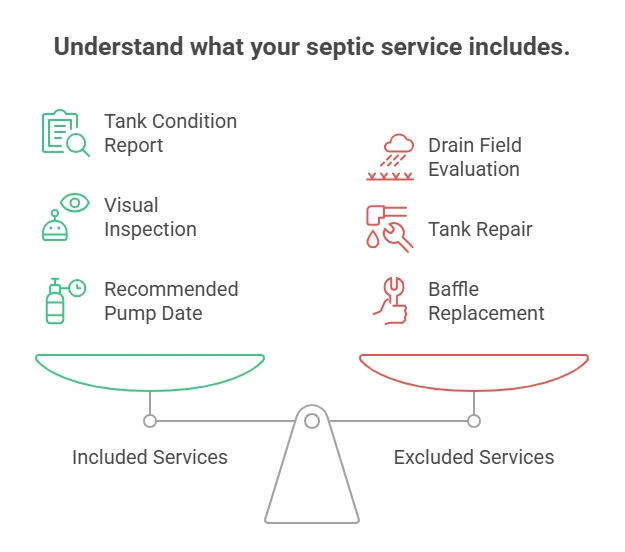
Ranges are only useful if you know what is inside them. Here is what a pump-out with us includes:
The report is the part I care about. Anybody can empty a tank. Telling you what was in it is the job.
- Locating the tank access if it is not already known, which on most lots takes me about 20 minutes with a probe rod.
- Pumping the accumulated solids and scum out of the tank.
- Visual inspection of the baffles and tank walls while the tank is empty and visible.
- A report on tank condition and a recommended next pump date based on what was actually in there.
And here is what is not included, which is just as important when you are comparing quotes:
- Drain field evaluation, which is a separate service because it is a different assessment.
- Tank repair, which is quoted separately if damage is found.
- Replacement of damaged baffles, which can be quoted at the time of pumping if needed.
The condition report is the line item that changes what you get for your money. Without it you paid for a service and learned nothing. With it, your next interval stops being a guess. If a quote does not mention a report, ask whether one is included before you compare it against anything else.
Note that pumping and installation are entirely different scopes with entirely different cost structures. If you are actually looking at a new or replacement system rather than a service, the installation cost factors are a separate conversation.
On an aerobic system, pumping is one line on a bigger bill
Aerobic tanks still accumulate solids and still need pumping. But pumping is not the whole cost of owning one.
Texas requires a maintenance contract on every aerobic system. That is a state requirement, not a service add-on and not something a contractor talked you into. Under TCEQ rules a licensed maintenance provider must submit reports at least once every four months, extending to six months on systems with electronic monitoring, and most contracts run quarterly visits. Letting the contract lapse creates a compliance violation.
So the honest comparison is not aerobic pumping against conventional pumping. It is total cost of ownership. Aerobic systems carry ongoing maintenance costs that conventional systems do not, and any comparison that leaves that out is not telling you the truth about either one. Whether you get to choose is a separate matter, because the TCEQ notes that most soils in Texas cannot properly absorb pollutants on their own, so alternative treatment is often required rather than selected.
What an aerobic maintenance contract actually buys is worth knowing. Chlorine level check, spray head inspection and adjustment, air pump operation, alarm test, and a dissolved oxygen reading in the aeration chamber.
It also buys you somebody who will tell you when you do not need a truck. A homeowner off Old Jacksonville Highway called me at 7 AM on a Saturday with her aerobic alarm going. Two other numbers had gone to voicemail. I asked three questions before anything else: pump run time in the last 24 hours, when chlorine tablets were last added, and whether there had been unusual water use the night before. The answers pointed to a float sensor, not a pump. I walked her through the control panel over the phone, the float cleared, the alarm went off. No truck, no service call, and the pump was fine the whole time. Running that pump dry on a false high-level reading is how you burn a motor out.
Most alarm calls are a chlorine tablet issue. Sending a truck to every one of them wastes the homeowner's money and my crew's day.
What a cheap quote can cost you later
Two ways this goes wrong, and neither one is dramatic.
The first is paying for a pump-out and getting no information. The tank gets emptied, the truck leaves, and you know exactly as much as you did that morning. Three years later you are guessing again. That is not a cheap service, that is an incomplete one. I will not tell an owner the tank is fine when it is not. I have seen tanks a previous contractor called acceptable and I did not agree, and the repair that follows from ignoring a baffle that needed replacing costs more and disrupts more than the straight answer would have.
The second is money spent on the wrong diagnosis entirely. A homeowner in Flint had dead brown patches showing up in her lawn. She assumed fungus, called a lawn service, paid for treatment, watched the patches come back, and paid for treatment again. On the third call somebody suggested the septic system. I walked the yard before touching any equipment, and the damage was a clean semi-circle. That is a spray head pattern, not a fungal ring. Two heads were clogged and putting down nothing, two were over-rotating past the property line, one was flooding a low spot near a grade change. The lawn came back in two growing seasons with no fungicide and no reseeding.
She had spent a year treating a symptom. The service call that costs you least is the one that identifies the actual problem, and that is true whether the issue turns out to be the tank, the spray field, or a drain field repair nobody had considered.
How to read a septic pumping quote
Six questions. Ask them before you compare totals, because a lower number that excludes half the work is not a lower number.
I would rather a homeowner ask me all six of these than book blind and find out later that digging was extra.
- Does the price include locating the tank if nobody knows where it is?
- If the lid is buried, is the digging included or billed separately?
- Is a written condition report included, covering sludge depth and baffle condition?
- What happens to the price if damage is found during the pump-out?
- Is disposal included in the quoted figure?
- Is the contractor registered with TCEQ to transport septage?
That last one is not a formality. It is a state requirement for anyone hauling what comes out of your tank, and it is worth confirming.
Getting a real number for your property
Every range on this page is a national figure from somebody else's survey. None of them looked at your tank, your driveway, or your last pump date.
I have never quoted a tank I have not seen and been right about it more than roughly. Nobody can.
We do not publish pricing, because a useful estimate starts with questions, not a price list. Cost depends on the specific service, the system's location and condition, access to the work area, and whether repairs are involved. On-site estimates are free and there is no obligation attached to one.
Rose City Septic Co. has served Tyler since 2005, and we cover Whitehouse, Bullard, Flint, Lindale, Chandler, Jacksonville and Kilgore. Call or text (903) 857-7325 with your property location, your tank size if you know it, and roughly when it was last pumped, or request a free estimate online. Response is usually same day.
Sources
- US EPA — Septic Systems (Decentralized / Onsite Systems)
- TCEQ — On-Site Sewage Facility Maintenance Requirements
- Texas A&M AgriLife Extension — on-site sewage facility guidance
- Ohio State University Extension (Ohioline) — septic pumping interval tables
Common Questions Answered
Frequently Asked Questions
How much does it cost to empty a 1,000-gallon septic tank?
Published national ranges put it between roughly $225 and $700, and the two surveys cited on this page disagree by a wide margin, which tells you how much the local job matters. A 1,000-gallon tank is the Texas minimum for a three-bedroom house, so it is the most common size around Tyler. Where you land in that range depends mostly on access, how long it has been, and whether the lid is buried.
Is it cheaper to pump more often or to wait as long as possible?
Waiting does not save money, it defers it and adds risk. A tank that has gone far past its interval takes longer to pump because the sludge has compacted, and the real exposure is the drain field. The EPA puts a failed conventional system at $5,000 to $15,000 against $250 to $500 for routine maintenance. Stretching an interval to skip one $400 service is a bad trade against that.
Does the price go up if the tank has not been pumped in years?
Often, yes. Compacted sludge takes more time and sometimes takes water back into the tank to break it up, and time is the main input. The bigger cost is not the pump-out though. It is whatever the solids did on their way toward the outlet baffle while you waited.
Is septic pumping cheaper in rural areas?
Sometimes, and sometimes the opposite. One published survey lists rural work as low as $200, but rural also means a longer drive, softer ground, longer hose runs, and gates and drives that were not built for a vacuum truck. A property 35 minutes out with a tight approach can cost more than an easy in-town job, not less.
Does an aerobic system cost more to maintain than a conventional one?
Over time, yes. Aerobic systems have components that conventional systems do not, and Texas requires a maintenance contract on every one of them with reporting at least once every four months. That is not optional and it is not an upsell. The pumping itself is comparable. The ongoing maintenance is the difference.
Do septic additives save money on pumping?
No. Additives do not remove sludge from a tank. Only pumping removes sludge from a tank. Whatever a product does to the biology, the solids sitting on the bottom are still sitting on the bottom, and the outlet baffle does not care what went down the drain.
Get Clear Septic Answers Today
Talk with a local team that has served Tyler since 2005. Tell us about your property, and we will help you understand the right next step with a free estimate.
(903) 857-7325Or fill out the form — we'll be in touch shortly.