
How often does a septic tank need to be emptied?
What emptying actually means, how often it is due, and why the tank does not stay empty afterwards.
TL;DR
- Most tanks need emptying every 3 to 5 years depending on usage, and a 1,000-gallon tank serving four people works out closer to 2.6 years.
- Emptying and pumping are the same service with two different words. Cleaning is a looser term and worth asking about before you book it.
- Your tank is never actually left empty, and it should not be, because it treats wastewater by holding it long enough for solids to settle.
- It refills to its working level within a few days of being serviced, and that is the system working rather than failing.
- The liquid level tells you nothing about whether it is due. The sludge depth at the outlet baffle is the number that decides it.
When somebody asks me how often their tank needs emptying, the word tells me what they think is down there.
Emptied suggests a container that fills up with waste, gets drained, and sits empty until it fills again. That is not what a septic tank is. It is a settling chamber, and it does its job by staying full of liquid.
So the honest answer comes in two parts. How often it needs doing, which has a number. And what actually happens when it gets done, which is where most of the confusion lives.
How often a septic tank needs to be emptied
The general guidance from the EPA and from the Texas Commission on Environmental Quality, the state agency that regulates septic systems here, is the same: every 3 to 5 years depending on usage.
That is a planning range, not your number. Yours comes from tank size and how many people are using it.
| Tank size | 3 people | 4 people | 6 people |
|---|---|---|---|
| 750 gallons | 2.6 years | 1.8 years | 1.0 years |
| 1,000 gallons | 3.7 years | 2.6 years | 1.5 years |
| 1,500 gallons | 5.9 years | 4.2 years | 2.6 years |
Figures from an extension table published by Ohio State University Extension for a year-round residence.
A three-bedroom house in Texas is most likely on a 1,000-gallon tank, because that is the state minimum for that size of house. So the most common answer around Tyler is somewhere near two and a half to four years, depending on headcount.
I have pumped tanks on a 3-year schedule that looked like nobody had touched them in a decade, and tanks at 5 years with room to spare. The chart gets you a date to plan around. What is actually in the tank corrects it.
For the full breakdown across every tank size and household, we cover it in our guide to pumping frequency by tank size and household size.
Emptying, pumping and cleaning are three words for mostly the same job
Emptying is the homeowner's word. Pumping is the word we use. Same truck, same hose, same job. If you call and ask to have your tank emptied, nobody in this trade is confused about what you want.
Cleaning is where it gets loose. Some contractors use it to mean exactly what pumping means. Others use it to mean pumping plus washing down the tank walls, or pumping plus a filter service. It is not a standardized term, and I have had customers tell me a previous contractor cleaned their tank when what they got was a straight pump-out with a different word on the invoice.
So the useful question is not what the word means. It is what is included.
What a pump-out actually covers
Here is what a pump-out with us includes:
- Locating the tank access if it is not already known, which on most lots takes me about 20 minutes with a probe rod.
- Pumping the accumulated solids and scum out of the tank.
- Visual inspection of the baffles and tank walls while the tank is empty and visible.
- A report on tank condition and a recommended next pump date based on what was actually in there.
And what is not included, which matters just as much when you are comparing quotes:
- Drain field evaluation, which is a separate service because it is a different assessment.
- Tank repair, which is quoted separately if damage is found.
- Replacement of damaged baffles, which can be quoted at the time of pumping if needed.
The report is the line that changes what you get for your money. Anybody can move sludge into a truck. Telling you what the sludge depth was, and when to book the next one, is the part that stops you guessing for the next three years.
What to ask when somebody says cleaning
Ask three things. Is the tank access included if nobody knows where the lid is. Is a written condition report included. And what happens to the price if damage is found once the tank is open.
If the answers match the list above, you are buying the same service under a different name. If they do not, you have found the difference between the two quotes, and it is usually not the word.
Your tank is never actually emptied, and it should not be
This is the part that surprises people.
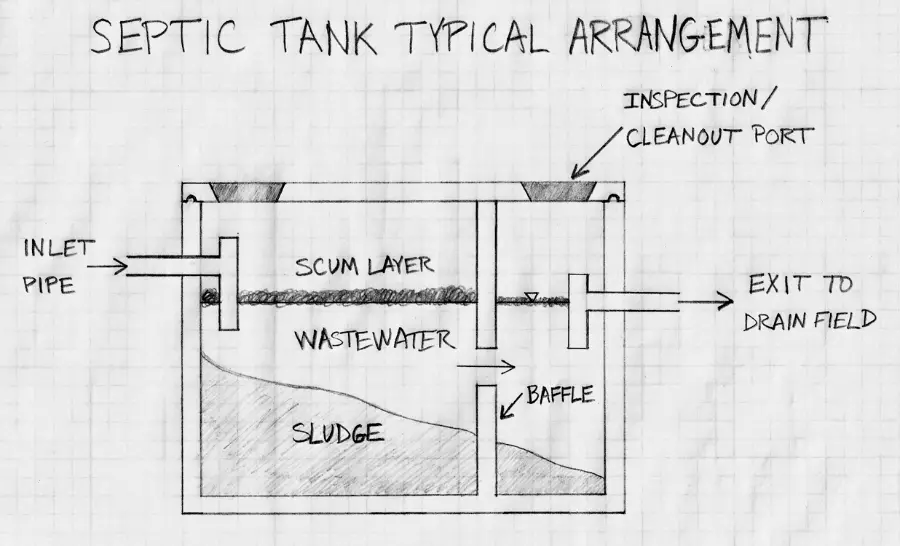
Inside the tank, wastewater separates into three layers. The EPA describes it plainly: grease and oil float to the top as scum, solids settle to the bottom as sludge, and the middle layer is the liquid, called effluent. Compartments and a T-shaped outlet keep the scum and sludge from following the effluent out to the drain field.
What that arrangement needs is depth. Solids settle through liquid. Take the liquid away and nothing settles, because there is nothing to settle through. Penn State puts the design target at at least 24 hours of settling and treatment before effluent moves on.
So what leaves in the truck is the accumulated sludge and scum. Not the working volume. A tank that has been serviced properly is a tank with its sludge removed, and it goes right back to sitting full of liquid, because that is the condition it treats in.
What I am looking for when I pull the lid is not how full it is. It is how much of that middle layer is left between the sludge and the scum.
Why it fills back up in three or four days
Run the arithmetic yourself and it stops being alarming.
The EPA puts average indoor water use at up to 70 gallons per person per day. Four people in a house is 280 gallons a day going into the system. A 1,000-gallon tank is back to its working level in roughly three or four days.
That is a calculation, not a published figure, and I would rather show you the two numbers than hand you a claim.
The mechanism behind it is the part worth understanding. The tank does not fill from empty like a bucket. As new wastewater comes in, it displaces the treated liquid out through the outlet to the drain field. The level sits at the outlet and stays there. That is where it is supposed to be.
So a customer who looks in the lid a week after service and sees liquid up near the outlet has not been shortchanged. They have a working tank. The thing that would actually be wrong is a tank sitting well below its outlet, because that usually means a leak.
So how do you know when it actually needs emptying
Not by looking at it. This is the single most useful thing on this page, and I say it on almost every job.
The liquid level is the same the day after service and the day before the next one. What changes is the sludge on the bottom and the scum on top, and neither is visible from the access lid without measuring.
Three published thresholds, all saying the same thing in different words:
Oklahoma State Extension puts it at pumping once the sludge layer reaches 25 to 33 percent of liquid capacity, measured near the outlet baffle. The outlet baffle is the fitting that holds back floating scum and lets clarified liquid pass through to the drain field.
Texas A&M AgriLife says to pump before sludge or scum accumulates to the bottom of the outlet device.
The EPA gives a general rule of solids reaching two-thirds of tank volume.
They converge on the same deadline. Once solids climb to the outlet, they start going out to the field, and the field is the expensive part of your system.
Penn State puts the accumulation rate in context: one adult produces roughly 90 gallons of solids a year, cut to about 60 once bacteria have worked on it, and a 1,000-gallon tank has around 300 gallons of usable sludge storage. That is why four people land near two and a half years and two people land near six.
If your last service was somebody's recollection rather than a document, you do not have a schedule, you have a guess. One septic inspection with a measured sludge depth converts it into a real date.
What makes it need emptying sooner
A garbage disposal is the biggest single adjustment. Texas A&M states that disposals reduce pump-out intervals by 1 to 2 years. On a 1,000-gallon tank with four people, that moves you from about 2.6 years to somewhere near 1.5.
Water volume matters because more flow means less settling time. The EPA notes one running toilet can add as much as 200 gallons a day by itself, which on a tank designed around 400 gallons a day is half the design flow arriving with no settling behind it.
Then there is what goes down the drain. Only human waste and toilet paper belong in the toilet, and the EPA is specific about the rest: grease and cooking oils, wipes including the ones labeled flushable, coffee grounds, cat litter, paper towels. Grease is the one I see most, because it thickens the scum layer and eats your working volume from the top while sludge eats it from the bottom.
You do not need to add bacteria afterwards
Two versions of this come up, and I hear both regularly. Both are wrong.
The first is that a tank needs an additive after service to get the bacteria going again. The EPA does not recommend septic tank additives, describes them as unnecessary for operation, and notes they can be ineffective or even harm system operation. Its reasoning is direct: onsite systems already contain the bacteria, enzymes, yeasts, fungi and microorganisms needed to function properly.
The second is that a contractor should leave some sludge behind to reseed the tank. Think about what sludge actually is. Penn State describes it as the material that does not break down, accumulating at the bottom of the tank. Bacteria are not in short supply down there and they arrive again with the next flush. Leaving sludge behind does not seed anything. It just means you paid to remove less of what you were paying to have removed.
If somebody tells you they left a foot of sludge on purpose, I would ask why the price was the same.
If your system is aerobic, emptying is only part of it
An aerobic system still accumulates solids and still needs emptying on its own schedule. But pumping is not the whole maintenance picture on one of these.
Texas requires a maintenance contract on every aerobic system. That is a state requirement, not a service add-on. Under TCEQ rules a licensed maintenance provider must submit reports at least once every four months, extending to six months on systems with electronic monitoring, and most contracts run quarterly visits. Letting it lapse creates a compliance violation.
I meet plenty of owners who do not know which type they have. From the access lid a conventional tank and an aerobic unit can look close to identical, and only one of them carries a state obligation. If you are not sure, that is the first thing to settle, because an aerobic maintenance contract is not optional and finding out late is an expensive way to learn it.
Who is allowed to empty a septic tank in Texas
Worth knowing before you compare prices on a truck.
What comes out of your tank cannot be taken anywhere convenient. In Texas, only people registered with TCEQ may pump and transport septic tank sludge. The disposal site, the drive to it, and the compliance behind it are priced into any legitimate quote, whether or not the quote breaks it out.
If a number comes in well under everything else you have been quoted, that is the first question I would ask.
Getting a real date instead of a guess
If you know your tank size and how many people are in the house, the table above gives you a working date today. What settles it is the sludge depth at the outlet baffle, and that only gets measured when somebody opens the tank and looks. Give me the tank size and the headcount and I can tell you roughly when to book. Give me a sludge reading and I can tell you exactly.
We do not publish pricing, because a useful estimate starts with questions rather than a price list. Cost depends on the specific service, the system's location and condition, access to the work area, and whether repairs are involved. On-site estimates are free and there is no obligation attached to one.
Rose City Septic Co. has served Tyler since 2005, and we cover Whitehouse, Bullard, Flint, Lindale, Chandler, Jacksonville and Kilgore. Call or text (903) 857-7325 with your tank size and roughly when it was last serviced, or request a free estimate. Response is usually same day, and every pump-out comes back with a condition report and a next date based on what was actually in the tank.
Common Questions Answered
Frequently Asked Questions
How often does a septic tank need to be emptied?
Typically every 3 to 5 years depending on usage. A 1,000-gallon tank, which is the Texas minimum for a three-bedroom house, works out to about 3.7 years for three people and 2.6 for four. Add a garbage disposal and cut 1 to 2 years off whichever number applies.
Is a septic tank completely emptied when it is pumped?
The sludge and scum come out. The tank then refills with liquid, and it is supposed to. A septic tank treats wastewater by holding it long enough for solids to settle, so a tank sitting empty would not be treating anything. What you are paying to remove is the accumulation, not the working volume.
How long after emptying does a septic tank fill back up?
A few days for most households. At the EPA's figure of up to 70 gallons per person per day, four people put 280 gallons through the system daily, so a 1,000-gallon tank is back to working level in roughly three or four days. After that the level holds steady at the outlet, because incoming wastewater displaces treated liquid out to the drain field rather than raising the level.
Is emptying a septic tank the same as pumping it?
Yes. Two words, one service. Cleaning is the term to watch, because it is not standardized and different contractors include different things under it. Ask what is covered rather than what it is called.
Does a septic tank need emptying if it is not backing up?
Yes, and this is the expensive mistake. A backup happens after the tank has been overfull long enough to push solids into the drain field, which means the costly part has already started. Emptying is preventive. The whole point is that it happens before anything visible does.
Do you need to add bacteria after emptying a septic tank?
No. The EPA does not recommend additives and states that onsite systems already contain the bacteria and microorganisms they need. Nothing needs restarting after a pump-out, and no product removes sludge from a tank. Only pumping does that.
Get Clear Septic Answers Today
Talk with a local team that has served Tyler since 2005. Tell us about your property, and we will help you understand the right next step with a free estimate.
(903) 857-7325Or fill out the form — we'll be in touch shortly.